Astrophysics | The Euclid satellite begins building the largest map of the Cosmos. Unife is also part of the team
Science, culture and research
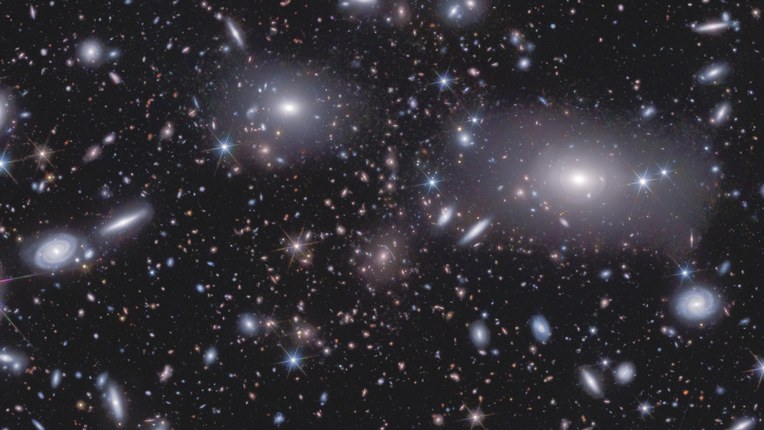
The University of Ferrara has also contributed to the important new discoveries made by the Euclid space mission of the European Space Agency (ESA), which recently made public data on more than 900 million galaxies, laying the foundations for the largest three-dimensional map of the Universe ever created.
Among the most significant findings is the identification of more than 15,000 candidates for gravitational lenses, extremely rare phenomena predicted by Einstein, which are essential for observing the most distant galaxies and studying mysterious dark matter.
“Euclid is opening a new era in the study of the Universe, making data of unprecedented quality and quantity available to the scientific community,” says Paolo Natoli, Director of the Department of Physics and Earth Sciences at the University of Ferrara. “It is a great source of satisfaction to see our university contribute to an international undertaking of this scale, drawing on expertise ranging from astrophysics to cosmology. The achievement is all the more significant because so many young researchers and students are involved, leading cutting-edge scientific research.”
Unife’s contribution to the study of gravitational lenses
The University’s astrophysics group, led by Piero Rosati, contributed to this result by developing sophisticated artificial intelligence algorithms capable of automatically identifying these phenomena among hundreds of millions of galaxies, with the direct involvement of young Unife researchers and students.
But what are gravitational lenses? They are genuine cosmic mirages: when two galaxies are aligned, the gravitational force of the nearer one can bend and magnify the light coming from the more distant one, creating distorted or multiple images. This extremely rare phenomenon allows astrophysicists to observe objects that would otherwise be invisible and to reconstruct the distribution of dark matter in the Universe.
“The identification of thousands of new gravitational lenses opens up important prospects for the study of dark matter and the most distant galaxies,” notes Piero Rosati of the University of Ferrara . “We are particularly pleased to have contributed to these results, thanks in part to the work of our young researchers and students, who played an active role in developing the analysis techniques and carrying out the studies.”
The contribution from Ferrara is reflected in two scientific studies led respectively by Michele Fogliardi, a Unife PhD student, and Pietro Bergamini, a researcher at INAF in Bologna and a former student of the University, in collaboration with Massimo Meneghetti of INAF. The research also involved PhD students Giorgia Di Rosa and Stefano Callegaro, student Marta Melloni, and Lorenzo Bazzanini, now at INAF in Bologna and formerly a Unife PhD student.
The University of Ferrara is also taking part in the Euclid mission through the University and Ferrara INFN section’s cosmology group, which is involved in analysing data to deepen our understanding of the origins and evolution of the Universe. Its members include Unife faculty members Mario Ballardini, Paolo Natoli, and Luca Pagano; Massimiliano Lattanzi of INFN Ferrara; Alessandro Gruppuso of INAF in Bologna; and Antonio Raffaelli, a Unife postdoctoral researcher.
Almost a billion galaxies in Euclid’s first major catalog
The Data Release 1 – Foundation has been published. It is the first part of the major Data Release 1 from the Euclid space mission of the European Space Agency (ESA), to which Italy contributes through the Italian Space Agency (ASI), the National Institute for Astrophysics (INAF), the National Institute for Nuclear Physics (INFN), and numerous universities.
The impressive catalog lists nine hundred million galaxies in around 10,000 images, covering 1,900 square degrees of sky—an area equivalent to about 9,500 full moons—and also includes 15,000 strong gravitational lens candidates, 60 million quasar candidates, and spectroscopic data for 160 million sources, laying the groundwork for the largest three-dimensional map of the universe ever created.
Euclid’s objective, launched in 2023, is to scan a third of the celestial sphere, observing billions of galaxies to investigate the history of the universe and uncover the mysteries of its most enigmatic components: dark matter and dark energy. The data released today, based on 13 months of observations, about a decade of algorithm development, and a year of processing and analysis, represent just 14% of the sky survey that Euclid will carry out over six years. Even so, they are enough to begin assembling the magnificent three-dimensional map of the cosmos that researchers have eagerly awaited, in order to start unraveling the mysteries of the dark universe.
Infrared images to see ever farther
“The more than 70,000 near-infrared images included in Data Release 1 make it possible to look ever farther into the Universe, revealing faint and distant galaxies and providing essential information for measuring their distances and reconstructing the three-dimensional distribution of matter,” comments Gianluca Polenta of ASI’s Space Science Data Center, who leads the team that developed the software for processing and producing the near-infrared images and is the first author of one of the scientific papers accompanying the Data Release.
Groups, clusters and gravitational lenses to study the evolution of the cosmos
The new catalogue includes a large sample of galaxy groups and clusters, the largest structures in today’s cosmos, including the Horologium Supercluster and several galaxies belonging to the M81 Group. The data collected will make it possible to study the formation and evolution of these structures. It also includes approximately 15,000 candidates for strong gravitational lenses, systems in which a chance cosmic alignment produces multiple images, arcs or rings of light from even more distant galaxies.
160 million spectra to build the 3D map of the universe
Data Release 1 – Foundation covers a patch of sky thirty times larger than that covered by Euclid’s previous release, which was made public last year. In addition to images captured by the two onboard instruments, VIS (Visible Instrument) and NISP (Near Infrared Spectrometer Photometer), it also includes spectroscopic data obtained with NISP for 160 million sources.
“Extracting calibrated spectra from such a vast volume of data required the Italian Science Data Center team to undertake complex work to design and optimize the analysis software for the NISP instrument, adapting it to the Science Ground Segment’s distributed computing infrastructure,” says Marco Frailis of INAF, head of Euclid’s Italian Science Data Center.
A spectrum, obtained by breaking down the light from galaxies into its different colors, can be compared to a barcode: it provides valuable information about their chemical composition and makes it possible to estimate their distance. This is why galaxy spectra are essential for turning Euclid’s celestial atlas into a three-dimensional map of the cosmos, needed to investigate the nature of dark matter and dark energy.
“INFN and INAF collaborate on NISP’s in-flight operations, monitoring its functioning and verifying its performance during observations,” explains Stefano Dusini, INFN’s national lead for the Euclid mission. “This work, carried out in close coordination with the international consortium, is essential to ensuring the quality and reliability of the data on which studies of dark matter and dark energy will be based.”
New data in 2027 to investigate dark matter and dark energy
Around mid-2027, the Euclid mission will publish the complete version of Data Release 1, expanding on the version made available today with additional information about the distribution of galaxies and clusters within the vast network of cosmic structures that permeates the universe. This will make it possible to study the clustering of galaxies (galaxy clustering), that is, the way galaxies are distributed in space and trace the large-scale structure of the universe. It will also contain measurements of the effect of “weak” gravitational lensing, that is, the slight distortion of galaxy images caused by the distribution of matter along the line of sight. The combined analysis of these two phenomena will be essential to reconstruct the evolution of cosmic structures and investigate the nature of dark matter and dark energy.
Italy’s role
The mission is one of the most ambitious international programmes, in which Italy, through ASI, INAF and INFN, plays a leading role, involving hundreds of Italian scientists from numerous universities, including the University of Bologna, the University of Milan, the University of Genoa, the University of Trieste, SISSA, the University of Ferrara, the University of Turin and the University of Padua.
Italy leads Euclid’s ground segment, the complex chain of activities responsible for verifying the performance of the instruments in orbit and processing the data received from the satellite, producing the images and spectra needed for scientific analysis, such as those made available in today’s release. Italy also contributed to the development of the two scientific instruments, VIS and NISP, designed the mission’s observing strategy and hosts one of the nine Science Data Centers, located at ALTEC in Turin.