<?xml version="1.0" encoding="utf-8" ?>
<rdf:RDF xmlns:rdf="http://www.w3.org/1999/02/22-rdf-syntax-ns#" xmlns:dc="http://purl.org/dc/elements/1.1/" xmlns:syn="http://purl.org/rss/1.0/modules/syndication/" xmlns="http://purl.org/rss/1.0/">


<channel rdf:about="https://www.unife.it/progetto/neurolab/search_rss">
  <title>Neurolab</title>
  <link>https://www.unife.it/progetto</link>

  <description>
    
            These are the search results for the query, showing results 1 to 15.
        
  </description>


  <image rdf:resource="https://www.unife.it/progetto/logo.png"/>

  <items>
    <rdf:Seq>
      
        <rdf:li rdf:resource="https://www.unife.it/progetto/neurolab/home"/>
      
      
        <rdf:li rdf:resource="https://www.unife.it/progetto/neurolab"/>
      
      
        <rdf:li rdf:resource="https://www.unife.it/progetto/neurolab/publications"/>
      
      
        <rdf:li rdf:resource="https://www.unife.it/progetto/neurolab/pdf/2015_07_Cavallo_Lungu_Becchio_Ansuini_Rustichini_Fadiga.pdf"/>
      
      
        <rdf:li rdf:resource="https://www.unife.it/progetto/neurolab/pdf/2015_06_Finisguerra_Maffongelli_Bassolino_Jacono_Pozzo_DAusilio.pdf"/>
      
      
        <rdf:li rdf:resource="https://www.unife.it/progetto/neurolab/pdf/2015_05_DAusilio_Badino_Cipresso_Chirico_Ferrari_Riva_Gaggioli.pdf"/>
      
      
        <rdf:li rdf:resource="https://www.unife.it/progetto/neurolab/pdf/2015_3_DAusilio_Bartol_Maffongelli.pdf"/>
      
      
        <rdf:li rdf:resource="https://www.unife.it/progetto/neurolab/people"/>
      
      
        <rdf:li rdf:resource="https://www.unife.it/progetto/neurolab/image/logo.jpg-1"/>
      
      
        <rdf:li rdf:resource="https://www.unife.it/progetto/neurolab/upf/upf"/>
      
      
        <rdf:li rdf:resource="https://www.unife.it/progetto/neurolab/lab-facilities"/>
      
      
        <rdf:li rdf:resource="https://www.unife.it/progetto/neurolab/contacts"/>
      
      
        <rdf:li rdf:resource="https://www.unife.it/progetto/neurolab/image/neurolab_brain.jpg"/>
      
      
        <rdf:li rdf:resource="https://www.unife.it/progetto/neurolab/research"/>
      
      
        <rdf:li rdf:resource="https://www.unife.it/progetto/neurolab/pdf/2014_2_GaveauJBerretBDemougeotLFadigaLPozzoTPapaxanthisC.pdf"/>
      
    </rdf:Seq>
  </items>

</channel>


  <item rdf:about="https://www.unife.it/progetto/neurolab/home">
    <title>Home</title>
    <link>https://www.unife.it/progetto/neurolab/home</link>
    <description></description>
    <content:encoded xmlns:content="http://purl.org/rss/1.0/modules/content/"><![CDATA[<p><img src="https://www.unife.it/progetto/neurolab/image/logo.jpg-1" alt="Neurolab" class="image-inline" title="logo.jpg" /></p>
<p>The aim of the Center for Translational Neurophysiology of Speech and Communication <a class="external-link" href="https://www.iit.it/it/centri/ctnsc-unife" target="_blank">CTNSC@UniFe</a> is twofold. On one side we are studying how the brain builds communicative and linguistic representations. On the other side we are designing new brain interfaces, specifically conceived for human use, to record and computationally decode neural signals. A particular focus of the Center is on communication because we believe that many paralyzing pathologies require, at first, the restoring of an efficient communicative flow between the patient and the environment. To this purpose we are studying the way by which the brain processes and understands the communicative behaviors of other individuals in order to efficiently decode the brain signals related to communicative intentions, we are applying innovative and possibly biologically-compatible technologies to the problem of automatic speech and action recognition (Speech and Communication Team) and we are designing a new generation of brain electrodes characterized by reduced invasiveness, improved resolution and sensitivity (Neural Interfaces Team). In summary, with a critical focus on translational methodologies (single unit recordings, Micro-ECoG, fMRI, EEG, TMS), our research goal is to advance knowledge on brain functioning to help building the next generation of brain-computer interfaces. The group research activities span from basic research to applied one along three main research lines: Design of long-term and stable neural-tissue interfaces Research on brain centers and circuits involved in action/speech understanding Research on new efficient methods for automatic speech recognition Collaborations with other National and international labs are fundamental. A particularly intense collaboration is running between CTNSC@UniFe and the Neurosurgery Unit of Udine Hospital (M. Skrap).</p>]]></content:encoded>
    <dc:publisher>No publisher</dc:publisher>
    <dc:creator>roby</dc:creator>
    <dc:rights></dc:rights>
    <dc:date>2020-06-30T09:05:26Z</dc:date>
    <dc:type>Pagina</dc:type>
  </item>


  <item rdf:about="https://www.unife.it/progetto/neurolab">
    <title>Neurolab</title>
    <link>https://www.unife.it/progetto/neurolab</link>
    <description>The aim of the Center for Translational Neurophysiology of Speech and Communication CTNSC@UniFe is twofold. On one side we are studying how the brain builds communicative and linguistic representations. On the other side we are designing new brain interfaces, specifically conceived for human use, to record and computationally decode neural signals. A particular focus of the Center is on communication because we believe that many paralyzing pathologies require, at first, the restoring of an efficient communicative flow between the patient and the environment.

To this purpose we are studying the way by which the brain processes and understands the communicative behaviors of other individuals in order to efficiently decode the brain signals related to communicative intentions, we are applying innovative and possibly biologically-compatible technologies to the problem of automatic speech and action recognition (Speech and Communication Team) and we are designing a new generation of brain electrodes characterized by reduced invasiveness, improved resolution and sensitivity (Neural Interfaces Team).

In summary, with a critical focus on translational methodologies (single unit recordings, Micro-ECoG, fMRI, EEG, TMS), our research goal is to advance knowledge on brain functioning to help building the next generation of brain-computer interfaces. The group research activities span from basic research to applied one along three main research lines:

Design of long-term and stable neural-tissue interfaces
Research on brain centers and circuits involved in action/speech understanding
Research on new efficient methods for automatic speech recognition
Collaborations with other National and international labs are fundamental. A particularly intense collaboration is running between CTNSC@UniFe and the Neurosurgery Unit of Udine Hospital (M. Skrap).</description>
    
    <dc:publisher>No publisher</dc:publisher>
    <dc:creator>Rosario Canto</dc:creator>
    <dc:rights></dc:rights>
    <dc:date>2020-06-30T09:05:26Z</dc:date>
    <dc:type>Cartella</dc:type>
  </item>


  <item rdf:about="https://www.unife.it/progetto/neurolab/publications">
    <title>Publications</title>
    <link>https://www.unife.it/progetto/neurolab/publications</link>
    <description></description>
    <content:encoded xmlns:content="http://purl.org/rss/1.0/modules/content/"><![CDATA[<p><strong>2016</strong></p>
<p> </p>
<p><strong>2015</strong></p>
<ol>
<li>D'Ausilio A, Novembre G, Fadiga L, Keller PE<br /><a class="external-link" href="http://www.ncbi.nlm.nih.gov/pubmed/25641075" target="_blank">What can music tell us about social interaction?</a><br />Trends Cogn Sci. 2015 Mar;19(3):111-4. doi: 10.1016/j.tics.2015.01.005. Epub 2015 Jan 29 [<a href="https://www.unife.it/progetto/neurolab/pdf/2015_1_dausilio-a-novembre-g-fadiga-l-keller-pe.pdf/at_download/file" type="application/pdf" class="internal-link internal-link-tofile" target="_blank">PDF</a>]</li>
<li>D'Ausilio A, Bartoli E, Maffongelli L<br /><a class="external-link" href="https://www.ncbi.nlm.nih.gov/pubmed/25792432" target="_blank">Motor control may support mirror neuron research with new hypotheses and methods: reply to comments on "Grasping synergies: a motor-control approach to the mirror neuron mechanism"</a><br />Phys Life Rev. 2015 Mar;12:133-7. doi: 10.1016/j.plrev.2015.02.005. Epub 2015 Mar 3. [<a href="https://www.unife.it/progetto/neurolab/pdf/2015_3_DAusilio_Bartol_Maffongelli.pdf/at_download/file" type="application/pdf" class="internal-link internal-link-tofile" target="_blank">PDF</a>]</li>
<li>de Bertoldi F, Finos L, Maieron M, Weis L, Campanella M, Ius T, Fadiga L<br /><a class="external-link" href="http://www.ncbi.nlm.nih.gov/pubmed/25862262" target="_blank">Improving the reliability of single-subject fMRI by weighting intra-run variability<br /></a>Neuroimage. 2015 Jul 1;114:287-93. doi: 10.1016/j.neuroimage.2015.03.076. Epub 2015 Apr 8 [<a href="https://www.unife.it/progetto/neurolab/pdf/2015_05_DAusilio_Badino_Cipresso_Chirico_Ferrari_Riva_Gaggioli.pdf/at_download/file" type="application/pdf" class="internal-link internal-link-tofile" target="_blank">PDF</a>]</li>
<li>Maffongelli L, Bartoli E, Sammler D, Kölsch S, Campus C, Olivier E, Fadiga L, D'Ausilio A<br /><a class="external-link" href="http://www.ncbi.nlm.nih.gov/pubmed/26004058" target="_blank">Distinct brain signatures of content and structure violation during action observation</a><br />Neuropsychologia. 2015 Aug;75:30-9. doi: 10.1016/j.neuropsychologia.2015.05.020. Epub 2015 May 22 [<a href="https://www.unife.it/progetto/neurolab/pdf/2015_3_maffongelli-l-bartoli-e-sammler-d-kolsch-s-campus-c-olivier-e-fadiga-l-dausilio-a.pdf/at_download/file" type="application/pdf" class="internal-link internal-link-tofile" target="_blank">PDF</a>]</li>
<li>D'Ausilio A, Badino L, Cipresso P, Chirico A, Ferrari E, Riva G, Gaggioli A<br /><a class="external-link" href="https://www.ncbi.nlm.nih.gov/pubmed/26224265" target="_blank">Automatic imitation of the arm kinematic profile in interacting partners</a><br />Cogn Process. 2015 Sep;16 Suppl 1:197-201. doi: 10.1007/s10339-015-0699-4. [<a href="https://www.unife.it/progetto/neurolab/pdf/2015_05_DAusilio_Badino_Cipresso_Chirico_Ferrari_Riva_Gaggioli.pdf/at_download/file" type="application/pdf" class="internal-link internal-link-tofile" target="_blank">PDF</a>]</li>
<li>Finisguerra A, Maffongelli L, Bassolino M, Jacono M, Pozzo T, D'Ausilio A<br /><a class="external-link" href="https://www.ncbi.nlm.nih.gov/pubmed/26289463" target="_blank">Generalization of motor resonance during the observation of hand, mouth, and eye movements</a><br />J Neurophysiol. 2015 Oct;114(4):2295-304. doi: 10.1152/jn.00433.2015. Epub 2015 Aug 19 [<a href="https://www.unife.it/progetto/neurolab/pdf/2015_06_Finisguerra_Maffongelli_Bassolino_Jacono_Pozzo_DAusilio.pdf/at_download/file" type="application/pdf" class="internal-link internal-link-tofile" target="_blank">PDF</a>]</li>
<li>Cavallo A, Lungu O, Becchio C, Ansuini C, Rustichini A, Fadiga L<br /><a class="external-link" href="https://www.ncbi.nlm.nih.gov/pubmed/26080312" target="_blank">When gaze opens the channel for communication: Integrative role of IFG and MPFC</a><br />Neuroimage. 2015 Oct 1;119:63-9. doi: 10.1016/j.neuroimage.2015.06.025. Epub 2015 Jun 12 [<a href="https://www.unife.it/progetto/neurolab/pdf/2015_07_Cavallo_Lungu_Becchio_Ansuini_Rustichini_Fadiga.pdf/at_download/file" type="application/pdf" class="internal-link internal-link-tofile" target="_blank">PDF</a>]<br /><br /></li>
</ol>
<p><strong>2014</strong></p>
<ol>
<li>Ius T Pauletto G Isola M Gregoraci G, Budai R Lettieri C Eleopra R Fadiga L Skrap M<br /><a class="external-link" href="http://thejns.org/doi/abs/10.3171/2013.9.JNS13728?url_ver=Z39.88-2003&amp;rfr_id=ori:rid:crossref.org&amp;rfr_dat=cr_pub%3dpubmed" target="_blank">Surgery for insular low-grade glioma: predictors of postoperative seizure outcome</a><br />Journal of Neurosurgery 2014 Jan [<a href="https://www.unife.it/progetto/neurolab/pdf/2014_1_ius-t-pauletto-g-isola-m-gregoraci-g-budai-r-lettieri-c-eleopra-r-fadiga-l-skrap-m.pdf/at_download/file" type="application/pdf" class="internal-link internal-link-tofile" target="_blank">PDF</a>]</li>
<li>Gaveau J, Berret B, Demougeot L, Fadiga L, Pozzo T, Papaxanthis C<br /><a class="external-link" href="http://www.ncbi.nlm.nih.gov/pubmed/24133223" target="_blank">Energy-related optimal control accounts for gravitational load: comparing shoulder, elbow, and wrist rotations</a><br />Journal of Neurophysiology 2014 Jan 1 [<a href="https://www.unife.it/progetto/neurolab/pdf/2014_2_GaveauJBerretBDemougeotLFadigaLPozzoTPapaxanthisC.pdf/at_download/file" type="application/pdf" class="internal-link internal-link-tofile" target="_blank">PDF</a>]</li>
<li>De Faveri S, Maggiolini E, Miele E, De Angelis F, Cesca F, Benfenati F, Fadiga L<br /><a class="external-link" href="http://www.ncbi.nlm.nih.gov/pmc/articles/PMC3989589/" target="_blank">Bio-inspired hybrid microelectrodes: a hybrid solution to improve long-term performance of chronic intracortical implants</a><br />Frontiers in Neuroengineering 2014 Mar 6 [<a href="https://www.unife.it/progetto/neurolab/pdf/2014_3_de-faveri-s-maggiolini-e-miele-e-de-angelis-f-cesca-f-benfenati-f-fadiga-l.pdf/at_download/file" type="application/pdf" class="internal-link internal-link-tofile" target="_blank">PDF</a>]</li>
<li>Castagnola E, Ansaldo A, Maggiolini E, Ius T, Skrap M, Ricci D, Fadiga L<br /><a class="external-link" href="http://www.ncbi.nlm.nih.gov/pmc/articles/PMC3997015/" target="_blank">Smaller, softer, lower-impedance electrodes for human neuroprosthesis: a pragmatic approach</a><br />Frontiers in Neuroengineering 2014 Apr 16 [<a href="https://www.unife.it/progetto/neurolab/pdf/2014_4_castagnola-e-ansaldo-a-maggiolini-e-ius-t-skrap-m-ricci-d-fadiga-l.pdf/at_download/file" type="application/pdf" class="internal-link internal-link-tofile" target="_blank">PDF</a>]</li>
<li><span>Broz F, Nehaniv CL, Belpaeme T, Bisio A, Dautenhahn K, Fadiga L, Ferrauto T, Fischer K, Förster F, Gigliotta O, Griffiths S, Lehmann H, Lohan KS, Lyon C, Marocco D, Massera G, Metta G, Mohan V, Morse A, Nolfi S, Nori F, Peniak M, Pitsch K, Rohlfing KJ, Sagerer G, Sato Y, Saunders J, Schillingmann L, Sciutti A, Tikhanoff V, Wrede B, Zeschel A, Cangelosi A.<br /><a class="external-link" href="http://www.ncbi.nlm.nih.gov/pubmed/24934294#" target="_blank">The ITALK project: a developmental robotics approach to the study of individual, social, and linguistic learning</a><br />Top Cogn Sci. 2014 Jul;6(3):534-44. doi: 10.1111/tops.12099. Epub 2014 Jun 17</span></li>
<li><span>Badino L, D'Ausilio A, Fadiga L, Metta G.<br /><a class="external-link" href="http://www.ncbi.nlm.nih.gov/pubmed/24935820" target="_blank">Computational validation of the motor contribution to speech perception</a><br />Top Cogn Sci. 2014 Jul;6(3):461-75. doi: 10.1111/tops.12095. Epub 2014 Jun 17</span></li>
<li>D'Ausilio A, Bartoli E, Maffongelli L, Berry JJ, Fadiga L<br /><a class="external-link" href="http://www.ncbi.nlm.nih.gov/pubmed/25172391" target="_blank">Vision of tongue movements bias auditory speech perception</a><br />Neuropsychologia. 2014 Oct;63:85-91. doi: 10.1016/j.neuropsychologia.2014.08.018. Epub 2014 Aug 27 [<a href="https://www.unife.it/progetto/neurolab/pdf/2014_7_dausilio-a-bartoli-e-maffongelli-l-berry-jj-fadiga-l.pdf/at_download/file" type="application/pdf" class="internal-link internal-link-tofile" target="_blank">PDF</a>]</li>
<li><span>Angotzi GN, Baranauskas G, Vato A, Bonfanti A, Zambra G, Maggiolini E, Semprini M, Ricci D, Ansaldo A, Castagnola E, Ius T, Skrap M, Fadiga L.<br /><a class="external-link" href="http://www.ncbi.nlm.nih.gov/pubmed/25486648" target="_blank">A compact and autoclavable system for acute extracellular neural recording and brain pressure monitoring for humans</a><br />IEEE Trans Biomed Circuits Syst. 2015 Feb;9(1):50-9. doi: 10.1109/TBCAS.2014.2312794. Epub 2014 Jun 3</span></li>
<li>D'Ausilio A, Maffongelli L, Bartoli E, Campanella M, Ferrari E, Berry J, Fadiga L.<br /><a class="external-link" href="http://www.ncbi.nlm.nih.gov/pubmed/24778384" target="_blank">Listening to speech recruits specific tongue motor synergies as revealed by transcranial magnetic stimulation and tissue-Doppler ultrasound imaging</a><br />Philos Trans R Soc Lond B Biol Sci. 2014 Apr 28;369(1644):20130418. doi: 10.1098/rstb.2013.0418. Print 2014 [<a href="https://www.unife.it/progetto/neurolab/pdf/2014_9_dausilio-a-maffongelli-l-bartoli-e-campanella-m-ferrari-e-berry-j-fadiga-l.pdf/at_download/file" type="application/pdf" class="internal-link internal-link-tofile" target="_blank">PDF</a>]</li>
<li>Campanella M, Ius T, Skrap M, Fadiga L.<br /><a class="external-link" href="http://www.ncbi.nlm.nih.gov/pubmed/25250209" target="_blank">Alterations in fiber pathways reveal brain tumor typology: a diffusion tractography study</a><br />PeerJ. 2014 Sep 9;2:e497. doi: 10.7717/peerj.497. eCollection 2014 [<a href="https://www.unife.it/progetto/neurolab/pdf/2014_10_campanella-m-ius-t-skrap-m-fadiga-l.pdf/at_download/file" type="application/pdf" class="internal-link internal-link-tofile" target="_blank">PDF</a>]</li>
<li>Bisio A, Sciutti A, Nori F, Metta G, Fadiga L, Sandini G, Pozzo T.<br /><a class="external-link" href="http://www.ncbi.nlm.nih.gov/pubmed/25153990" target="_blank">Motor contagion during human-human and human-robot interaction</a><br />PLoS One. 2014 Aug 25;9(8):e106172. doi: 10.1371/journal.pone.0106172. eCollection 2014</li>
</ol>
<p> </p>
<p><strong>2013</strong></p>
<ol>
<li><span>Ricciardi E, Handjaras G, Bonino D, Vecchi T, Fadiga L, Pietrini P<br /></span><span><a class="external-link" href="http://www.plosone.org/article/info%3Adoi%2F10.1371%2Fjournal.pone.0058632" target="_blank">Beyond motor scheme: a supramodal distributed representation in the action-observation network</a><br /></span><span>PLoS One 2013 Mar 5 [PDF]</span></li>
<li><span>Elsner C, D'Ausilio A, Gredebäck G, Falck-Ytter T, Fadiga L<br /></span><span><a class="external-link" href="http://www.sciencedirect.com/science/article/pii/S0028393212005210" target="_blank">The motor cortex is causally related to predictive eye movements during action observation</a><br /></span><span>PLoS One 2013 Mar 5 [PDF]</span></li>
<li><span>Busan P, D'Ausilio A, Borelli M, Monti F, Pelamatti G, Pizzolato G, Fadiga L<br /></span><span><a class="external-link" href="http://www.sciencedirect.com/science/article/pii/S0028393212005210" target="_blank">Motor excitability evaluation in developmental stuttering: a transcranial magnetic stimulation study</a><br /></span><span>Cortex 2013 Mar [PDF]</span></li>
<li><span>Castagnola E, Ansaldo A, Maggiolini E, Angotzi GN, Skrap M, Ricci D, Fadiga L<br /></span><span><a class="external-link" href="http://www.sciencedirect.com/science/article/pii/S0028393212005210" target="_blank">Biologically compatible neural interface to safely couple nanocoated electrodes to the surface of the brain</a><br /></span><span>ACS Nano 2013 May 28 [PDF]</span></li>
<li><span>Canevari C, Badino L, D'Ausilio A, Fadiga L, Metta G<br /></span><span><a class="external-link" href="http://journal.frontiersin.org/Journal/10.3389/fpsyg.2013.00364/full" target="_blank">Modeling speech imitation and ecological learning of auditory-motor maps</a><br /></span><span>Front. Psychol 2013 Jun 27 [PDF]</span></li>
<li><span>Fadiga L, Caselli L, Craighero L, Gesierich B, Oliynyk A, Tia B, Viaro R<br /></span><span><a class="external-link" href="https://peerj.com/articles/88/" target="_blank">Activity in ventral premotor cortex is modulated by vision of own hand in action</a><br /></span><span>PeerJ 2013 Jul 2 [PDF]</span></li>
<li><span>Bassolino M, Campanella M, Bove M, Pozzo T, Fadiga L<br /></span><span><a class="external-link" href="http://cercor.oxfordjournals.org/content/early/2013/07/26/cercor.bht190.long" target="_blank">Training the Motor Cortex by Observing the Actions of Others During Immobilization</a><br /></span><span>Cerebral Cortex 2013 Jul 29 [PDF]</span></li>
<li><span>Bartoli E, D'Ausilio A, Berry J, Badino L, Bever T, Fadiga L<br /></span><span><a class="external-link" href="http://cercor.oxfordjournals.org/content/early/2013/09/16/cercor.bht257.long" target="_blank">Listener-Speaker Perceived Distance Predicts the Degree of Motor Contribution to Speech Perception</a><br /></span><span>Cerebral Cortex 2013 Sep 17 [PDF]</span></li>
</ol>
<p> </p>
<p><strong>2012</strong></p>
<ol>
<li><span>Bianco G, Feurra M, Fadiga L, Rossi A, Rossi S<br /></span><span><a class="external-link" href="http://iospress.metapress.com/content/p48030n227137827/?genre=article&amp;issn=0922-6028&amp;volume=30&amp;issue=6&amp;spage=481" target="_blank">Bi-hemispheric effects on corticospinal excitability induced by repeated sessions of imagery versus observation of actions</a><br /></span><span>Restorative Neurology and Neuroscience 2012 Jul 31</span></li>
<li><span>D'Ausilio A, Badino L, Li Y, Tokay S, Craighero L, Canto R, Aloimonos Y, Fadiga L<br /></span><span><a class="external-link" href="http://www.plosone.org/article/info%3Adoi%2F10.1371%2Fjournal.pone.0035757" target="_blank">Leadership in orchestra emerges from the causal relationships of movement kinematics</a><br /></span><span>PLoS One 2012 May 9 [PDF]</span></li>
<li><span>Franca M, Turella L, Canto R, Brunelli N, Allione L, Andreasi NG, Desantis M, Marzoli D, Fadiga L<br /></span><span><a class="external-link" href="http://www.plosone.org/article/info%3Adoi%2F10.1371%2Fjournal.pone.0049025" target="_blank">Corticospinal facilitation during observation of graspable objects: a transcranial magnetic stimulation study</a><br /></span><span>PLoS One Nov 2012 [PDF]</span></li>
<li><span>Vato A, Semprini M, Maggiolini E, Szymanski FD, Fadiga L, Panzeri S, Mussa-Ivaldi FA<br /></span><span><a class="external-link" href="http://www.ploscompbiol.org/article/info%3Adoi%2F10.1371%2Fjournal.pcbi.1002578" target="_blank">Shaping the dynamics of a bidirectional neural interface</a><br /></span><span>PLoS Comput Biol Jul 2012 [PDF]</span></li>
<li><span>Clerget E, Poncin W, Fadiga L, Olivier E<br /></span><span><a class="external-link" href="http://www.mitpressjournals.org/doi/abs/10.1162/jocn_a_00108?url_ver=Z39.88-2003&amp;rfr_id=ori:rid:crossref.org&amp;rfr_dat=cr_pub%3dpubmed&amp;#.U7prgbmKCmw" target="_blank">Role of Broca's area in implicit motor skill learning: evidence from continuous theta-burst magnetic stimulation</a><br /></span><span>J Cogn Neurosci Jan 2012 [PDF]</span></li>
<li><span>Baranauskas G, Maggiolini E, Vato A, Angotzi G, Bonfanti A, Zambra G, Spinelli A, Fadiga L<br /></span><span><a class="external-link" href="http://jn.physiology.org/content/107/3/984.long" target="_blank">Origins of 1/f2 scaling in the power spectrum of intracortical local field potential</a><br /></span><span>J Neurophysiol Feb 2012 [PDF]</span></li>
<li><span>Skrap M, Mondani M, Tomasino B, Weis L, Budai R, Pauletto G, Eleopra R, Fadiga L, Ius T<br /></span><span><a class="external-link" href="http://www.ncbi.nlm.nih.gov/pubmed/22067417" target="_blank">Surgery of insular nonenhancing gliomas: volumetric analysis of tumoral resection, clinical outcome, and survival in a consecutive series of 66 cases</a><br /></span><span>Neurosurgery May 2012</span></li>
<li><span>Oliynyk A, Bonifazzi C, Montani F, Fadiga L<br /></span><span><a class="external-link" href="http://www.biomedcentral.com/1471-2202/13/96" target="_blank">Automatic online spike sorting with singular value decomposition and fuzzy C-mean clustering</a><br /></span><span>BMC Neuroscience Aug 2012</span></li>
<li><span>Ius T, Isola M, Budai R, Pauletto G, Tomasino B, Fadiga L, Skrap M<br /></span><span><a class="external-link" href="http://thejns.org/doi/abs/10.3171/2012.8.JNS12393?url_ver=Z39.88-2003&amp;rfr_id=ori:rid:crossref.org&amp;rfr_dat=cr_pub%3dpubmed&amp;" target="_blank">Low-grade glioma surgery in eloquent areas: volumetric analysis of extent of resection and its impact on overall survival. A single-institution experience in 190 patients: clinical article</a><br /></span><span>J Neurosurg Dec 2012 [PDF]</span></li>
<li><span>Lettieri C, Rinaldo S, Devigili G, Pauletto G, Verriello L, Budai R, Fadiga L, Oliynyk A, Mondani M, D'Auria S, Skrap M, Eleopra R<br /></span><span><a class="external-link" href="http://www.sciencedirect.com/science/article/pii/S1388245712003690" target="_blank">Deep brain stimulation: Subthalamic nucleus electrophysiological activity in awake and anesthetized patients</a><br /></span><span>Clinical Neurophysiology Dec 2012 [PDF]</span></li>
</ol>
<p> </p>
<p><strong>2011</strong></p>
<ol>
<li><span>Craighero L, Leo I, Umiltà C, Simion F.<br /></span><span><a class="external-link" href="http://www.ncbi.nlm.nih.gov/pubmed/21388616" target="_blank">Newborns' preference for goal-directed actions</a><br /></span><span>Cognition. 2011 Mar 7 [PDF]</span></li>
<li><span>Ansaldo A, Castagnola E, Maggiolini E, Fadiga L, Ricci D.<br /></span><span><a class="external-link" href="http://www.ncbi.nlm.nih.gov/pubmed/21341752" target="_blank">Superior electrochemical performance of carbon nanotubes directly grown on sharp microelectrodes</a><br /></span><span>ACS Nano. 2011 Mar 22;5(3):2206-14. Epub 2011 Feb 22</span></li>
<li><span>Tia B, Saimpont A, Paizis C, Mourey F, Fadiga L, Pozzo T.<br /></span><span><a class="external-link" href="http://www.ncbi.nlm.nih.gov/pubmed/20377627" target="_blank">Does observation of postural imbalance induce a postural reaction?</a><br /></span><span>PLoS One. 2011 Mar 15;6(3):e17799</span></li>
<li><span>D'Ausilio A, Bufalari I, Salmas P, Busan P, Fadiga L.<br /></span><span><a class="external-link" href="http://www.ncbi.nlm.nih.gov/pubmed/21458056" target="_blank">Vocal pitch discrimination in the motor system</a><br /></span><span>Brain Lang. 2011 Mar 30</span></li>
<li>Censolo R, Craighero L, Ponti G, Rizzo L, Canto R, Fadiga L.<br /><a class="external-link" href="http://www.ncbi.nlm.nih.gov/pubmed/21464986" target="_blank">Electromyographic activity of hand muscles in a motor coordination game: effect of incentive scheme and its relation with social capital</a><br />PLoS One. 2011 Mar 25;6(3):e17372 [PDF]</li>
<li><span>Senot P, D'Ausilio A, Franca M, Caselli L, Craighero L, Fadiga L.<br /></span><span><a class="external-link" href="http://www.ncbi.nlm.nih.gov/pubmed/21533701" target="_blank">Effect of weight-related labels on corticospinal excitability during observation of grasping: a TMS study</a><br /></span><span>Exp Brain Res. 2011 May;211(1):161-7. Epub 2011 Mar 29 [PDF]</span></li>
<li><span>D'Ausilio A, Bufalari I, Salmas P, Fadiga L.<br /></span><span><a class="external-link" href="http://www.sciencedirect.com/science/article/pii/S0010945211001614" target="_blank">The role of the motor system in discriminating normal and degraded speech sounds</a><br /></span><span>ELSERVIER (2011), Cortex doi:10.1016/j.cortex.2011.05.017 [PDF]</span></li>
<li><span>Clerget E, Poncin W, Fadiga L, Olivier E.<br /></span><span><a class="external-link" href="http://www.mitpressjournals.org/doi/abs/10.1162/jocn_a_00108?url_ver=Z39.88-2003&amp;rfr_id=ori:rid:crossref.org&amp;rfr_dat=cr_pub%3dpubmed" target="_blank">Role of Broca's Area in Implicit Motor Skill Learning: Evidence from Continuous Theta-burst Magnetic Stimulation</a><br /></span><span>J Neurosci. 2011 24:1, pp. 80–92 [PDF]</span></li>
<li><span>Castellini C, Badino L, Metta G, Sandini G, Tavella M, Grimaldi M, Fadiga L.<br /></span><span><a class="external-link" href="http://www.ncbi.nlm.nih.gov/pmc/articles/PMC3164679/?tool=pubmed" target="_blank">The use of phonetic motor invariants can improve automatic phoneme discrimination</a><br /></span><span>PLoS One. 2011;6(9):e24055 [PDF]</span></li>
<li><span>Baranauskas G, Maggiolini E, Castagnola E, Ansaldo A, Mazzoni A, Angotzi GN, Vato A, Ricci D, Panzeri S, Fadiga L.<br /></span><span><a class="external-link" href="http://iopscience.iop.org/1741-2552/8/6/066013/" target="_blank">Carbon nanotube composite coating of neural microelectrodes preferentially improves the multiunit signal-to-noise ratio</a><br /></span><span>J Neural Eng. 2011 Nov 8;8(6):066013 [PDF]</span></li>
<li><span>Skrap M, Mondani M, Tomasino B, Weis L, Budai R, Pauletto G, Eleopra R, Fadiga L, Ius T.<br /></span><span><a class="external-link" href="http://www.ncbi.nlm.nih.gov/pubmed/22067417" target="_blank">Surgery of insular non-enhancing Gliomas: volumetric analysis of tumoral resection, clinical outcome and survival in a consecutive series of 66 cases</a><br /></span><span>Neurosurgery 2011 Nov 3 [PDF]</span></li>
<li><span>Szymanski FD, Semprini M, Mussa-Ivaldi FA, Fadiga L, Panzeri S, Vato A.<br /></span><span><a class="external-link" href="http://ieeexplore.ieee.org/xpl/articleDetails.jsp?arnumber=6091137" target="_blank">Dynamic Brain-Machine Interface: a novel paradigm for bidirectional interaction between brains and dynamical systems</a><br /></span><span>Engineering in Medicine and Biology Society 2011</span></li>
</ol>
<p> </p>
<p><strong>2010</strong></p>
<ol>
<li><span>Giacomo Rizzolatti and Laila Craighero<br /></span><span><a class="external-link" href="http://www.scholarpedia.org/article/Premotor_theory_of_attention" target="_blank">Premotor theory of attention</a><br /></span><span>Scholarpedia; 5(1):6311 2010</span></li>
<li><span>Kotz SA, D'Ausilio A, Raettig T, Begliomini C, Craighero L, Fabbri-Destro M, Zingales C, Haggard P, Fadiga L.<br /></span><span><a class="external-link" href="http://www.ncbi.nlm.nih.gov/pubmed/19698980" target="_blank">Lexicality drives audio-motor transformations in Broca's area</a><br /></span><span>Brain Lang; Jan;112(1):3-11. 2010 [PDF]</span></li>
<li><span>Alaerts K, Senot P, Swinnen SP, Craighero L, Wenderoth N, Fadiga L.<br /></span><span><a class="external-link" href="http://www.ncbi.nlm.nih.gov/pubmed/20377627" target="_blank">Force requirements of observed object lifting are encoded by the observer's motor system: a TMS study</a><br /></span><span>Eur J Neurosci. 2010 Mar;31(6):1144-53</span></li>
<li><span>Pulvermüller F, Fadiga L.<br /></span><span><a class="external-link" href="http://www.ncbi.nlm.nih.gov/pubmed/20383203" target="_blank">Active perception: sensorimotor circuits as a cortical basis for language</a><br /></span><span>Nat Rev Neurosci. 2010 May;11(5):351-60. Epub 2010 Apr 9. Review</span></li>
<li><span>Mussa-Ivaldi FA, Alford ST, Chiappalone M, Fadiga L, Karniel A, Kositsky M, Maggiolini E, Panzeri S, Sanguineti V, Semprini M, Vato A.<br /></span><span><a class="external-link" href="http://www.ncbi.nlm.nih.gov/pubmed/20589094" target="_blank">New Perspectives on the Dialogue between Brains and Machines</a><br /></span><span>Front Neurosci. 2010 Apr 15;4:44</span></li>
<li><span>Metta G, Natale L, Nori F, Sandini G, Vernon D, Fadiga L, von Hofsten C, Rosander K, Lopes M, Santos-Victor J, Bernardino A, Montesano L.<br /></span><span><a class="external-link" href="http://www.ncbi.nlm.nih.gov/pubmed/20864311" target="_blank">The iCub humanoid robot: an open-systems platform for research in cognitive development</a><br /></span><span>Neural Netw. 2010 Oct-Nov;23(8-9):1125-34. Epub 2010 Sep 22. Review</span></li>
<li><span>Bisio A, Stucchi N, Jacono M, Fadiga L, Pozzo T.<br /></span><span><a class="external-link" href="http://www.ncbi.nlm.nih.gov/pubmed/20976006" target="_blank">Automatic versus voluntary motor imitation: effect of visual context and stimulus velocity</a><br /></span><span>PLoS One. 2010 Oct 20;5(10):e13506</span></li>
<li><span>Bonfanti A, Ceravolo M, Zambra G, Gusmeroli R, Spinelli AS, Lacaita AL, Angotzi GN, Baranauskas G, Fadiga L.<br /></span><span><a class="external-link" href="http://www.ncbi.nlm.nih.gov/pubmed/21096380" target="_blank">A multi-channel low-power system-on-chip for single-unit recording and narrowband wireless transmission of neural signal</a><br /></span><span>Conf Proc IEEE Eng Med Biol Soc. 2010;2010:1555-60</span></li>
</ol>
<p> </p>
<p><strong>2009</strong></p>
<ol>
<li><span>Fazio P, Cantagallo A, Craighero L, D'Ausilio A, Roy AC, Pozzo T, Calzolari F, Granieri E, Fadiga L.<br /></span><span><a class="external-link" href="http://brain.oxfordjournals.org/content/132/7/1980" target="_blank">Encoding of human action in Broca's area</a><br /></span><span>Brain, 2009; 132(Pt 7):1980-8 2009 [PDF]</span></li>
<li><span>D'Ausilio A, Pulvermüller F, Salmas P, Bufalari I, Begliomini C, Fadiga L.<br /></span><span><a class="external-link" href="http://www.sciencedirect.com/science/article/pii/S0960982209005569" target="_blank">The motor somatotopy of speech perception</a><br /></span><span>Curr Biol, 2009; 19(5):381-5. 2009 [PDF]</span></li>
<li><span>Fadiga L., Craighero L., D’Ausilio A.<br /></span><span><a class="external-link" href="http://www.ncbi.nlm.nih.gov/pubmed/19673823" target="_blank">Broca’s Area in language and music: the supramodal syntax hypothesis</a><br /></span><span>Ann NY Acad Sci, 2009; 1169: 448–458. 2009 [PDF]</span></li>
<li><span>Ricciardi E, Bonino D, Sani L, Vecchi T, Guazzelli M, Haxby JV, Fadiga L, Pietrini P.<br /></span><span><a class="external-link" href="http://www.ncbi.nlm.nih.gov/pubmed/19657025" target="_blank">Do we really need vision? How blind people "see" the actions of others</a><br /></span><span>J Neurosci; Aug 5;29(31):9719-24, 2009 [PDF]</span></li>
<li><span>Clerget E, Winderickx A, Fadiga L, Olivier E.<br /></span><span><a class="external-link" href="http://www.ncbi.nlm.nih.gov/pubmed/19809371" target="_blank">Role of Broca's area in encoding sequential human actions: a virtual lesion study</a><br /></span><span>Neuroreport; 28;20(16):1496-9, 2009 [PDF]</span></li>
</ol>
<p> </p>
<p><strong>2008</strong></p>
<ol>
<li><span>Rossi S., De Capua A., Pasqualetti P., Ulivelli M., Fadiga L., Falzarano V., Bartalini S., Passero S., Nuti D., Rossini P.M.<br /></span><span><a class="external-link" href="http://journals.plos.org/plosone/article?id=10.1371/journal.pone.0001702" target="_blank">Distinct Olfactory Cross-Modal Effects on the Human Motor System</a><br /></span><span>PLoS ONE - February 2008 - Volume 3 - Issue 2 - e1702 2008 [PDF]</span></li>
<li><span>Craighero L., Bonetti F., Massarenti L., Canto R., Fabbri Destro M., Fadiga L.<br /></span><span><a class="external-link" href="http://www.ncbi.nlm.nih.gov/pubmed/18394523" target="_blank">Temporal prediction of touch instant during observation of human and robot grasping</a><br /></span><span>Brain Research Bulletin, 75 (2008) 770–774. 2008 [PDF]</span></li>
<li><span>E. de Lussanet M., Fadiga L., Michels L., Seitz J., Kleiser R., Lappe M.<br /></span><span><a class="external-link" href="http://www.ncbi.nlm.nih.gov/pubmed/18215244" target="_blank">Interaction of visual hemifield and body view in biological motion perception</a><br /></span><span>European Journal of Neuroscience, Vol. 27, pp. 514–522, 2008 [PDF]</span></li>
<li><span>Rochat M., Serra E., Fadiga L., Gallese V.<br /></span><span><a class="external-link" href="http://www.sciencedirect.com/science/article/pii/S0960982207024177" target="_blank">The Evolution of Social Cognition: Goal Familiarity Shapes Monkeys’ Action Understanding</a><br /></span><span>Current Biology 18, 227–232, February 12, 2008 [PDF]</span></li>
<li><span>Roy A., Craighero L., Fabbri Destro M., Fadiga L.<br /></span><span><a class="external-link" href="http://www.ncbi.nlm.nih.gov/pubmed/18440210" target="_blank">Phonological and lexical motor facilitation during speech listening: A transcranial magnetic stimulation study</a><br /></span><span>Journal of Physiology - Paris 102 (2008) 101–105, 2008 [PDF]</span></li>
<li><span>Keysers C, Fadiga L.<br /></span><span><a class="external-link" href="http://www.ncbi.nlm.nih.gov/pubmed/18979388&quot; target=&quot;_blank&quot;&gt;The mirror neuron system: new frontiers&lt;/a&gt;&lt;br /&gt;" target="_blank">The mirror neuron system: new frontiers<br /></a></span><span>Soc Neurosci, 2008; 3(3-4):193-8, 2008</span></li>
</ol>
<p> </p>
<p><strong>2007</strong></p>
<ol>
<li>Fadiga L., Craighero L.<br /><a class="external-link" href="https://benjamins.com/#catalog/books/aicr.68.10fad/details" target="_blank">Cues on the origin of language. From electrophysiological data on mirror neurons and motor representationsIn S. Bråten</a> (Ed.), On Being Moved: From mirror neurons to empathy. Amsterdam, John Benjamins. 2007 [PDF]</li>
<li><span>Porro C.A., Martinig M., Facchin P., Maieron M., Jones A.K.P., Fadiga L.<br /></span><span><a class="external-link" href="http://www.ncbi.nlm.nih.gov/pubmed/17239452" target="_blank">Parietal cortex involvement in the localization of tactile and noxious mechanical stimuli: A transcranial magnetic stimulation study</a><br /></span><span>Behavioural Brain Research, 178, 183-189. 2007 [PDF]</span></li>
<li><span>Craighero L., Metta G., Sandini G, Fadiga L.<br /></span><span><a class="external-link" href="http://www.ncbi.nlm.nih.gov/pubmed/17920425" target="_blank">The mirror-neurons system: data and models</a><br /></span><span>Progress in Brain Research, Vol. 164, Chapter 3. 2007 [PDF]</span></li>
<li><span>Schütz-Bosbach S., Haggard P., Fadiga L., Craighero L.<br /></span><span><a class="external-link" href="http://www.oxfordhandbooks.com/view/10.1093/oxfordhb/9780198568926.001.0001/oxfordhb-9780198568926-e-030" target="_blank">Motor cognition: TMS studies of action generation</a><br /></span><span>Wasserman - June 2007 - chapter 30 - Page 463 - 2007 [PDF]</span></li>
<li><span>Fadiga L.<br /></span><span><a class="external-link" href="http://www.ncbi.nlm.nih.gov/pubmed/17428686" target="_blank">Functional magnetic resonance imaging: Measuring versus estimating</a><br /></span><span>NeuroImage 37 2007 1042–1044. 2007 [PDF]</span></li>
<li><span>Olivier E., Davare M., Andres M., Fadiga L.<br /></span><span><a class="external-link" href="http://www.ncbi.nlm.nih.gov/pubmed/18337084" target="_blank">Precision grasping in humans: from motor control to cognition</a><br /></span><span>ELSERVIER - Current Opinion in Neurobiology 2007, 17:644–648. 2007 [PDF]</span></li>
<li><span>Porro C.A., Facchin P., Fusi S., Dri G., Fadiga L.<br /></span><span><a class="external-link" href="http://www.ncbi.nlm.nih.gov/pubmed/17681358" target="_blank">Enhancement of force after action observation. Behavioral and  neurophysiological studies</a><br /></span><span>ELSERVIER - Neuropsychologia 45 (2007) 3114–3121 2007 [PDF]</span></li>
<li><span>Rizzolatti G. e Craighero L.<br /></span><span><a class="external-link" href="http://www.oxfordhandbooks.com/view/10.1093/oxfordhb/9780198568971.001.0001/oxfordhb-9780198568971-e-047" target="_blank">Language and mirror neurons</a><br /></span><span>In G. Gaskell (Ed.) Oxford Handbook of Psycholinguistics, Oxford University Press, Oxford. 2007 [PDF]</span></li>
</ol>
<p> </p>
<p><strong>2006</strong></p>
<ol>
<li><span>Fadiga L., Craighero L., Fabbri Destro M., Finos L., Cotillon-Williams N., Smith A.T., Castiello U.<br /></span><span><a class="external-link" href="http://www.ncbi.nlm.nih.gov/pubmed/18633777" target="_blank">Language in Shadow</a><br /></span><span>Social Neuroscience, 1, 77-89. 2006 [PDF]</span></li>
<li><span>Metta G., Sandini G., Natale L., Craighero L., Fadiga L.<br /></span><span><a class="external-link" href="http://connection.ebscohost.com/c/articles/21508760/understanding-mirror-neurons-bio-robotic-approach" target="_blank">Understanding mirror neurons: a bio-robotic approach</a><br /></span><span>Interaction Studies, 7(2), 197-232. 2006 [PDF]</span></li>
<li><span>Fadiga L., Craighero L.<br /></span><span><a class="external-link" href="http://www.ncbi.nlm.nih.gov/pubmed/16881255" target="_blank">Hand actions and speech representation in Broca's Area</a><br /></span><span>Cortex, 42, 486-490. 2006 [PDF]</span></li>
<li><span>Fadiga L., Craighero L.<br /></span><span><a class="external-link" href="http://books.google.it/books?id=o2cyg2ESltkC&amp;pg=PA101&amp;lpg=PA101&amp;dq=Cues+on+the+origin+of+language&amp;source=bl&amp;ots=hkXUuyUp9R&amp;sig=sB5YdeHk7zVMd_CfQRSs68gN43w&amp;hl=it&amp;sa=X&amp;ved=0ahUKEwiC2oaVjPDJAhUBlg4KHdwRB4QQ6AEIITAA#v=onepage&amp;q=Cues%20on%20the%20origin%20of%20language&amp;f=false" target="_blank">Cues on the origin of language</a></span></li>
<li><span>Fadiga L., Roy A. C., Fazio P., Craighero L.<br /></span><span><a class="external-link" href="http://www.pagepressjournals.org/index.php/jbr/article/view/4696" target="_blank">From hand actions to speech: evidence and speculations</a><br /></span><span>ATTENTION AND PERFORMANCE: Sensorimotor Foundations of Higher Cognition. Haggard P., Rossetti Y., &amp; Kawato M. (Eds.) 2006 [PDF]</span></li>
</ol>
<p> </p>
<p><strong>2005</strong></p>
<ol>
<li><span>Fadiga L., Craighero L., Olivier E.<br /></span><span><a class="external-link" href="http://www.ncbi.nlm.nih.gov/pubmed/15831405" target="_blank">Human motor cortex excitability during the perception of others’ action</a><br /></span><span>Current Opinion in Neurobiology, 14, 331–333. 2005 [PDF]</span></li>
</ol>
<p> </p>
<p><strong>2004</strong></p>
<ol>
<li><span>Fadiga L., Craighero L., Dri G., Facchin P., Fabbri Destro M., Porro C.A.<br /></span><span><a class="external-link" href="http://www.ncbi.nlm.nih.gov/pubmed/15135940" target="_blank">Corticospinal excitability during painful self-stimulation in humans: a transcranial magnetic stimulation study</a><br /></span><span>Neuroscience Letter, 361, 250–253. 2004 [PDF]</span></li>
<li><span>Rizzolati G., Craighero L.<br /></span><span><a class="external-link" href="http://www.ncbi.nlm.nih.gov/pubmed/15217330" target="_blank">The Mirror-Neuron System</a><br /></span><span>Annual Review of Neuroscience, 27, 169–192. 2004 [PDF]</span></li>
<li><span>Craighero L., Fadiga L., Nascimben M.<br /></span><span><a class="external-link" href="http://www.ncbi.nlm.nih.gov/pubmed/14972685" target="_blank">Eye position affects orienting of visuospatial attention</a><br /></span><span>Current Biology, 14, 331–333. 2004 [PDF]</span></li>
<li><span>Fadiga L., Craighero L.<br /></span><span><a class="external-link" href="http://www.ncbi.nlm.nih.gov/pubmed/15375346" target="_blank">Electrophysiology of action representation</a><br /></span><span>Journal of Clinical Neurophysiology, 21(3), 157-169. 2004 [PDF]</span></li>
<li><span>Vargas C.D., Olivier E., Craighero L., Fadiga L., Duhamel J.R., Sirigu A.<br /></span><span><a class="external-link" href="http://www.ncbi.nlm.nih.gov/pubmed/15142965" target="_blank">The influence of hand posture on corticospinal excitability during motor imagery: a transcranial magnetic stimulation study</a><br /></span><span>Cerebral Cortex, 14(11), 1200-1206. 2004 [PDF]</span></li>
</ol>
<p> </p>
<p><strong>2003</strong></p>
<ol>
<li><span>Vandermeeren Y., Bastings E., Fadiga L., Olivier E.<br /></span><span><a class="external-link" href="http://www.ncbi.nlm.nih.gov/pubmed/14499742" target="_blank">Long-latency motor evoked potentials in congenital hemiplegia</a><br /></span><span>Clinical Neurophysiology, 114(10), 1808-1818. 2003 [PDF]</span></li>
<li><span>Fadiga L., Craighero L.<br /></span><span><a class="external-link" href="http://www.ncbi.nlm.nih.gov/pubmed/14642302" target="_blank">New insights on sensorimotor integration: From hand action to speech perception</a><br /></span><span>Brain and Cognition, 53, 514-524. 2003 [PDF]</span></li>
</ol>
<p> </p>
<p><strong>2002</strong></p>
<ol>
<li><span>Craighero L., Bello A., Fadiga L., Rizzolatti G.<br /></span><span><a class="external-link" href="http://www.ncbi.nlm.nih.gov/pubmed/11749979" target="_blank">Hand action preparation influences the responses to hand pictures</a><br /></span><span>Neuropsychologia, 40(5), 492-502. 2002 [PDF]</span></li>
<li><span>Fadiga L., Craighero L., Buccino G., Rizzolatti G.<br /></span><span><a class="external-link" href="http://www.ncbi.nlm.nih.gov/pubmed/11849307" target="_blank">Speech listening specifically modulates the excitability of tongue muscles: a TMS study</a><br /></span><span>European Journal of Neuroscience, 15(2), 399-402. 2002 [PDF]</span></li>
</ol>
<p> </p>
<p><strong>2001</strong></p>
<ol>
<li><span>Baldissera F., Cavallari P., Craighero L., Fadiga L.<br /></span><span><a class="external-link" href="http://www.ncbi.nlm.nih.gov/pubmed/11135017" target="_blank">Modulation of spinal excitability during observation of hand actions in humans</a><br /></span><span>European Journal of Neuroscience, 13, 190-194. 2001 [PDF]</span></li>
<li><span>Buccino G., Binkofski F., Fink G.R., Fadiga L., Fogassi L., Gallese V., Seitz R.J., Zilles K., Rizzolatti G., Freund H.J.<br /></span><span><a class="external-link" href="http://www.ncbi.nlm.nih.gov/pubmed/11168545" target="_blank">Action observation activates premotor and parietal areas in a somatotopic manner: an fMRI study</a><br /></span><span>European Journal of Neuroscience, 13, 400-404. 2001 [PDF]</span></li>
<li><span>Fogassi L., Gallese V., Buccino G., Craighero L., Fadiga L., Rizzolatti G.<br /></span><span><a class="external-link" href="http://www.ncbi.nlm.nih.gov/pubmed/11222457" target="_blank">Cortical mechanisms for the visual guidance of hand grasping movements in the monkey: a reversible inactivation study</a><br /></span><span>Brain, 124, 571-586. 2001 [PDF]</span></li>
<li><span>Agus M., Bettio F., Gobbetti E., Fadiga L.<br /></span><span><a class="external-link" href="http://www.ncbi.nlm.nih.gov/pubmed/11317746" target="_blank">An integrated environment for steroscopic acquisition, off-line 3D elaboration, and visual presentation of biological actions</a><br /></span><span>In J. D. Westwood (Ed.), Medicine Meets Virtual Reality 2001. Amsterdam, The Netherlands. [PDF]</span></li>
<li><span>Umiltà M.A., Kohler E., Gallese V., Fogassi L., Fadiga L., Keysers C., Rizzolatti G.<br /></span><span><a class="external-link" href="http://www.ncbi.nlm.nih.gov/pubmed/11498058" target="_blank">I know what you are doing: a neurophysiological study</a><br /></span><span>Neuron, 2001, 31(1):155-65. 2001 [PDF]</span></li>
<li><span>Craighero L., Carta A., Fadiga L.<br /></span><span><a class="external-link" href="http://www.ncbi.nlm.nih.gov/pubmed/11711871" target="_blank">Peripheral oculomotor palsy affects orienting of visuospatial attention</a><br /></span><span>Neuroreport, 12(15), 3283-3286. 2001 [PDF]</span></li>
</ol>
<p> </p>
<p><strong>2000</strong></p>
<ol>
<li><span>Fadiga L., Craighero L., Fogassi L., Gallese V.<br /></span><span><a class="external-link" href="http://www.worldcat.org/title/representation-interne-de-laction-nouvelles-perspectives/oclc/717514901" target="_blank">Représentation interne de l’action: nouvelles perspectives</a><br /></span><span>Psychologie Francaise, 45-4. 2000</span></li>
</ol>
<p> </p>
<p><strong>1999</strong></p>
<ol>
<li><span>Fadiga L., Buccino G., Craighero L., Fogassi L., Gallese V., Pavesi G.<br /></span><span><a class="external-link" href="http://www.ncbi.nlm.nih.gov/pubmed/10080372" target="_blank">Corticospinal excitability is specifically modulated by motor imagery: a magnetic stimulation study</a><br /></span><span>Neuropsychologia, 37, 147-158. 1999 [PDF]</span></li>
<li><span>Rizzolatti G., Fadiga L., Fogassi L., Gallese V.<br /></span><span><a class="external-link" href="http://www.ncbi.nlm.nih.gov/pubmed/10349488?dopt=Abstract" target="_blank">Resonance behaviors and mirror neurons</a><br /></span><span>Archivio Italiano di Biologia, 137, 83-99. 1999</span></li>
<li><span>Craighero L., Fadiga L., Rizzolatti G., Umiltà C.<br /></span><span><a class="external-link" href="http://www.ncbi.nlm.nih.gov/pubmed/10641315" target="_blank">Action for perception: a motor-visual attentional effect</a><br /></span><span>Journal of Experimental Psychology: Human Perception and Performance, 25, 1673-1692. 1999 [PDF]</span></li>
<li><span>Gallese V., Craighero L., Fadiga L., Fogassi L.<br /></span><span>Perception through action<br /></span><span>Psiche - An interdisciplinary journal of research on consciousness. 1999 [HTML] [PDF]</span></li>
<li><span>Binkofski F., Buccino G., Fink G.R., Schnitzler A., Fadiga L., Fogassi L., Gallese V., Seitz R.J., Zilles K., Rizzolatti G., Freund HJ.<br /></span><span><a class="external-link" href="http://juser.fz-juelich.de/record/34925?ln=en" target="_blank">Topographic segregation for movement recognition in man. An fMRI-study</a><br /></span><span>Society for Neuroscience Abstracts, 25, 753.8. 1999</span></li>
</ol>
<p> </p>
<p><strong>1998</strong></p>
<ol>
<li><span>Craighero L., Fadiga L., Rizzolatti G., Umiltà C.A.<br /></span><span>Visuomotor Priming<br /></span><span>Visual Cognition, 5, 109-125. 1998 [PDF]</span></li>
<li>Rizzolatti G., Fadiga L.<br /><a class="external-link" href="http://www.ncbi.nlm.nih.gov/pubmed/9949817?dopt=Abstract" target="_blank">Grasping objects and grasping meanings: the dual role of monkey rostroventral premotor cortex</a> (area F5)<br />Novartis Foundation Symposium, 218, 81-103. 1998</li>
<li><span>Rizzolatti G., Craighero L.<br /></span><span><a class="external-link" href="http://www.scholarpedia.org/article/Premotor_theory_of_attention" target="_blank">Spatial attention: Mechanisms and theories</a><br /></span><span>In Sabourin et al. (Ed.), Advances in Psychological Science: Biological and Cognitive Aspects. Psychology Press, Hove, UK. 1998</span></li>
<li>Rizzolatti G., Craighero L.<br /><a class="external-link" href="http://cat.inist.fr/?aModele=afficheN&amp;cpsidt=2224931" target="_blank">De l’attention spatiale à l’attention vers </a>des objets: une extension de la théorie prémotrice de l’attention<br />Revue de Neuropsychologie, 8, 155-174. 1998</li>
</ol>
<p> </p>
<p><strong>1997</strong></p>
<ol>
<li><span>Sheliga B.M, Craighero L., Riggio L., Rizzolatti G.<br /></span><span><a class="external-link" href="http://www.ncbi.nlm.nih.gov/pubmed/9166923" target="_blank">Effects of spatial attention on directional manual and ocular responses</a><br /></span><span>Experimental Brain Research, 114, 339-351. 1997 [PDF]</span></li>
<li><span>Murata A., Fadiga L., Fogassi L., Gallese V., Raos V., Rizzolatti G.<br /></span><span><a class="external-link" href="http://www.ncbi.nlm.nih.gov/pubmed/9325390" target="_blank">Object representation in the ventral premotor cortex (area F5) of the monkey</a><br /></span><span>Journal of Neurophysiology, 78, 2226-2230. 1997 [PDF]</span></li>
<li><span>Fadiga L., Gallese V.<br /></span><span><a class="external-link" href="https://www.researchgate.net/publication/240752133_Action_Representation_and_Language_in_the_Brain" target="_blank">Action representation and language in the brain</a><br /></span><span>Theoretical Linguistics, 23, 267-280. 1997</span></li>
<li><span>Rizzolatti G., Fadiga L., Fogassi L., Gallese V.<br /></span><span><a class="external-link" href="http://www.sciencemag.org/content/277/5323/190.summary" target="_blank">The space around us</a><br /></span><span>Science, 277, 190-191. 1997 [HTML]</span></li>
<li><span>Gallese V., Fadiga L., Fogassi L., Luppino G., Murata A.<br /></span><span>A parietal-frontal circuit for hand grasping movements in the monkey: evidence from reversible inactivation experiments.<br /></span><span>In P. Thier and H. O. Karnath (Eds.), Parietal lobe contributions to orientation in 3D-space. Exp. Brain Res. Suppl. Series. Springer Publ., Berlin-New York. 1997</span></li>
<li><span>Grafton S.T., Fadiga L., Arbib M.A., Rizzolatti G.<br /></span><span><a class="external-link" href="http://www.ncbi.nlm.nih.gov/pubmed/09417966" target="_blank">Premotor cortex activation during observation and naming of familiar tools</a><br /></span><span>NeuroImage, 6, 231-236. 1997 [PDF]</span></li>
</ol>
<p> </p>
<p><strong>1996</strong></p>
<ol>
<li><span>Rizzolatti G., Fadiga L., Gallese V., Fogassi L.<br /></span><span><a class="external-link" href="http://www.ncbi.nlm.nih.gov/pubmed/8713554?dopt=Abstract" target="_blank">Premotor cortex and the recognition of motor actions</a><br /></span><span>Cognitive Brain Research, 3, 131-141. 1996</span></li>
<li><span>Gallese V., Fadiga L., Fogassi L., Rizzolatti G.<br /></span><span><a class="external-link" href="http://brain.oxfordjournals.org/content/119/2/593" target="_blank">Action recognition in the premotor cortex</a><br /></span><span>Brain, 119, 593-609. 1996 [PDF]</span></li>
<li><span>Fogassi L., Gallese V., Fadiga L., Luppino G., Matelli M., Rizzolatti G.<br /></span><span><a class="external-link" href="http://www.ncbi.nlm.nih.gov/pubmed/8836215?dopt=Abstract" target="_blank">Coding of peripersonal space in inferior premotor cortex (area F4)</a><br /></span><span>Journal of Neurophysiology, 76, 141-157. 1996</span></li>
<li><span>Rizzolatti G., Fadiga L., Matelli M., Bettinardi V., Paulesu E., Perani D., Fazio F.<br /></span><span><a class="external-link" href="http://www.ncbi.nlm.nih.gov/pubmed/8891654" target="_blank">Localization of grasp representations in human by PET: 1. Observation versus execution</a><br /></span><span>Experimental Brain Research, 111, 246-252. 1996</span></li>
<li><span>Fogassi L., Gallese V., Fadiga L., Rizzolatti G.<br /></span><span><a class="external-link" href="http://link.springer.com/chapter/10.1007%2F978-94-017-2403-6_4" target="_blank">Space coding in inferior premotor cortex (area F4): Facts and speculations</a><br /></span><span>In F. Lacquaniti and P. Viviani (Eds.), Neural Bases of Motor Behaviour. NATO ASI Series, Kluwer Academic Publishers, Dordrecht-Boston-London. 1996</span></li>
<li><span>Grafton S.T., Arbib M.A., Fadiga L., Rizzolatti G.<br /></span><span><a class="external-link" href="http://www.ncbi.nlm.nih.gov/pubmed/8951412" target="_blank">Localization of grasp representations in human by PET: 2. Observation versus imagination</a><br /></span><span>Experimental Brain Research, 112, 103-111. 1996 [PDF]</span></li>
<li><span>Craighero L., Fadiga L., Umiltà C.A., Rizzolatti G.<br /></span><span><a class="external-link" href="http://www.ncbi.nlm.nih.gov/pubmed/9051808?dopt=Abstract" target="_blank">Evidence for visuomotor priming effect</a><br /></span><span>Neuroreport, 8, 347-349. 1996 [PDF]</span></li>
</ol>
<p> </p>
<p><strong>1995</strong></p>
<ol>
<li><span>Fadiga L., Fogassi L., Pavesi G., Rizzolatti G.<br /></span><span><a class="external-link" href="http://www.ncbi.nlm.nih.gov/pubmed/7666169" target="_blank">Motor facilitation during action observation: a magnetic stimulation study</a><br /></span><span>Journal of Neurophysiology, 73(6), 2608-2611. 1995 [PDF]</span></li>
<li><span>Sheliga B.M., Riggio L., Craighero L., Rizzolatti G.<br /></span><span><a class="external-link" href="http://www.ncbi.nlm.nih.gov/pubmed/7766869" target="_blank">Spatial attention determined modifications in saccade trajectories</a><br /></span><span>NeuroReport, 6, 585-588. 1995</span></li>
</ol>
<p> </p>
<p><strong>1992</strong></p>
<ol>
<li><span>1.Fogassi L., Gallese V., di Pellegrino G., Fadiga L., Gentilucci M., Luppino G., Matelli M., Pedotti A., Rizzolatti G.<br /></span><span><a class="external-link" href="http://www.ncbi.nlm.nih.gov/pubmed/1644132" target="_blank">Space coding by premotor cortex</a><br /></span><span>Experimental Brain Research, 89, 686-690. 1992 [PDF]</span></li>
<li><span>Di Pellegrino G., Fadiga L., Fogassi L., Gallese V., Rizzolatti G.<br /></span><span><a class="external-link" href="http://www.ncbi.nlm.nih.gov/pubmed/1301372" target="_blank">Understanding motor events: a neurophysiological study</a><br /></span><span>Experimental Brain Research, 91, 176-180. 1992 [PDF]</span></li>
</ol>]]></content:encoded>
    <dc:publisher>No publisher</dc:publisher>
    <dc:creator>Canto Rosario</dc:creator>
    <dc:rights></dc:rights>
    <dc:date>2018-06-12T16:22:35Z</dc:date>
    <dc:type>Pagina</dc:type>
  </item>


  <item rdf:about="https://www.unife.it/progetto/neurolab/pdf/2015_07_Cavallo_Lungu_Becchio_Ansuini_Rustichini_Fadiga.pdf">
    <title>2015_07_Cavallo_Lungu_Becchio_Ansuini_Rustichini_Fadiga.pdf</title>
    <link>https://www.unife.it/progetto/neurolab/pdf/2015_07_Cavallo_Lungu_Becchio_Ansuini_Rustichini_Fadiga.pdf</link>
    <description></description>
    
    <dc:publisher>No publisher</dc:publisher>
    <dc:creator>Canto Rosario</dc:creator>
    <dc:rights></dc:rights>
    <dc:date>2018-06-12T16:21:30Z</dc:date>
    <dc:type>File</dc:type>
  </item>


  <item rdf:about="https://www.unife.it/progetto/neurolab/pdf/2015_06_Finisguerra_Maffongelli_Bassolino_Jacono_Pozzo_DAusilio.pdf">
    <title>2015_06_Finisguerra_Maffongelli_Bassolino_Jacono_Pozzo_DAusilio.pdf</title>
    <link>https://www.unife.it/progetto/neurolab/pdf/2015_06_Finisguerra_Maffongelli_Bassolino_Jacono_Pozzo_DAusilio.pdf</link>
    <description></description>
    
    <dc:publisher>No publisher</dc:publisher>
    <dc:creator>Canto Rosario</dc:creator>
    <dc:rights></dc:rights>
    <dc:date>2018-06-12T16:04:48Z</dc:date>
    <dc:type>File</dc:type>
  </item>


  <item rdf:about="https://www.unife.it/progetto/neurolab/pdf/2015_05_DAusilio_Badino_Cipresso_Chirico_Ferrari_Riva_Gaggioli.pdf">
    <title>2015_05_DAusilio_Badino_Cipresso_Chirico_Ferrari_Riva_Gaggioli.pdf</title>
    <link>https://www.unife.it/progetto/neurolab/pdf/2015_05_DAusilio_Badino_Cipresso_Chirico_Ferrari_Riva_Gaggioli.pdf</link>
    <description></description>
    
    <dc:publisher>No publisher</dc:publisher>
    <dc:creator>Canto Rosario</dc:creator>
    <dc:rights></dc:rights>
    <dc:date>2018-06-12T15:57:06Z</dc:date>
    <dc:type>File</dc:type>
  </item>


  <item rdf:about="https://www.unife.it/progetto/neurolab/pdf/2015_3_DAusilio_Bartol_Maffongelli.pdf">
    <title>2015_3_DAusilio_Bartol_Maffongelli.pdf</title>
    <link>https://www.unife.it/progetto/neurolab/pdf/2015_3_DAusilio_Bartol_Maffongelli.pdf</link>
    <description></description>
    
    <dc:publisher>No publisher</dc:publisher>
    <dc:creator>Canto Rosario</dc:creator>
    <dc:rights></dc:rights>
    <dc:date>2018-06-12T15:48:51Z</dc:date>
    <dc:type>File</dc:type>
  </item>


  <item rdf:about="https://www.unife.it/progetto/neurolab/people">
    <title>People</title>
    <link>https://www.unife.it/progetto/neurolab/people</link>
    <description></description>
    <content:encoded xmlns:content="http://purl.org/rss/1.0/modules/content/"><![CDATA[<ul>
<li>Luciano Fadiga</li>
<li>Alessandro D'Ausilio</li>
<li>Rosario Canto</li>
<li>Riccardo Viaro</li>
</ul>]]></content:encoded>
    <dc:publisher>No publisher</dc:publisher>
    <dc:creator>Canto Rosario</dc:creator>
    <dc:rights></dc:rights>
    <dc:date>2018-06-12T14:23:58Z</dc:date>
    <dc:type>Pagina</dc:type>
  </item>


  <item rdf:about="https://www.unife.it/progetto/neurolab/image/logo.jpg-1">
    <title>logo.jpg</title>
    <link>https://www.unife.it/progetto/neurolab/image/logo.jpg-1</link>
    <description>Neurolab</description>
    
    <dc:publisher>No publisher</dc:publisher>
    <dc:creator>Canto Rosario</dc:creator>
    <dc:rights></dc:rights>
    <dc:date>2018-06-05T15:51:45Z</dc:date>
    <dc:type>Immagine</dc:type>
  </item>


  <item rdf:about="https://www.unife.it/progetto/neurolab/upf/upf">
    <title>UPF</title>
    <link>https://www.unife.it/progetto/neurolab/upf/upf</link>
    <description></description>
    <content:encoded xmlns:content="http://purl.org/rss/1.0/modules/content/"><![CDATA[<p style="text-align: left; "><strong>UPF</strong></p>
<p>Usb to Parallel FIFO</p>
<p>A convenient and accurate parallel Input/Output USB device for E-Prime 2 Pro, and E-Prime 3.</p>
<p><img src="https://www.unife.it/progetto/neurolab/upf/upfsb.jpg" alt="" class="image-inline" title="" /></p>
<p><strong>Device Description</strong></p>
<p style="text-align: justify; ">The device include 8 logical TTL input/output ports (0 to +5V). Each port has a temporal resolution of 50 ns and the complete output voltage transition from GND to 5V takes approximately 400 µs. The device is controlled via microprocessor at 12 MHz. A Windows compatible .dll enable communication with the device.</p>
<p><strong>E-Prime Integration</strong><br />E-prime (v.2 Pro and v.3) integration was reached via a custom made Package, built with E-Prime Professional.</p>
<p style="text-align: justify; ">After loading our custom Package in E-Prime, one can send or receive a TTL pulse over a given port as typically done to command a PP pin read or write.</p>
<p style="text-align: justify; ">Our UPF device in integration with E-prime guarantee the millisecond accuracy required by Psychological and Neurophysiological experiments. We run extensive side by side comparisons between the parallel port and our UPF, please find it here.</p>
<p style="text-align: justify; "><strong>Direct USB</strong><br />Direct USB is a software that let's you flexibly and easily create personalized I/O "tasks". First you decide how many Input and Output channels to use, then you can set their behavior. For example you can generate output TTLs, with any delay, if some Input combination meet certain criteria.<br />Therefore you can use Direct USB to acquire external triggers, multiple response buttons and conditionally generate output pulses to control or synchronize external equipments.<br />TTLs can be sent also via the keyboard. Any four keyboard button can be associate to any output channel. If one of these buttons is pressed, 5V will be delivered through the associated output channel.<br />Direct USB is compatible with any Windows version starting from Win2000 and works only with our UPF device. (read more...)</p>
<p><strong>More</strong></p>
<p style="text-align: justify; ">Most psychological and neurophysiological experiments require the accurate control of stimuli generation, response recording as well as external devices synchronization. Such operations are typically performed via custom made or public software. For instance, the experimenter may want to measure different aspects of human behavior (i.e. button press, force sensors, optical or touch sensors, accelerometers, etc.) in association with other neurophysiological indices measured with external equipments (i.e. electroencephalography, functional magnetic resonance imaging, transcranial magnetic stimulation, etc.). These kind of experiments are based on the general assumption that one have to correlate brain states to measurable behavioral variables (Gazzaniga, Ivry, Mangun, 2002). Therefore, computer controlled experiments require particular accuracy and consistency when dealing with timing and synchrony among separate machines.<br />In recent years, several commercial or open source software have been proposed for the Experimental Control and Management (ECM) such as E-Prime, Presentation, PsyScope, or the PsychToolbox for MatLab, among others. In fact, we know that new generation operating systems are not optimized for timing accuracy (MacInnes, Taylor, 2001; Chambers, Brown, 2003; Plant, Hammond, Turner, 2004) and the advantage of using ECM software is that they are designed for this specific purpose, often incorporating low level routines and setting highest priority to them. In fact, these software guarantee millisecond accuracy in these operations and are productively used in thousands of labs around the world.<br />Synchronous recordings are typically achieved by relaying on a master computer controlling the experimental work-flow and by sending triggers to other computers (or external equipments). These triggers are then used by slave systems for synchronization, start acquisitions or even the generation of further commands. These basic I/O tasks are generally handled via the Parallel Port (PP). In fact, this port has proven to be a reliable and easy to use solution in psychological and neurophysiological settings (Voss, Leonhart, Stahl, 2007; Stewart, 2006).<br />Nevertheless, the PP is an end of life technology. The PP was originally developed to control printers and nowadays is being replaced by other ports such as the USB. Most recent motherboards do not include the PP and one must resort to PCI or PCI express external boards. However, different boards from different manufacturer may have different timing performance (http://www.pstnet.com/eprimeport.cfm) and one must pay particular attention when building a new experimental setup. Moreover, average laptops do not include a PP since few years. Until some time ago, laptops were not a suitable experimental platform due to inherent lack of performance. Newer generations of portable computers instead, offer quite enough power to run most kind of experiments, and in some cases they might even be the platform of choice. As a matter of facts, experiments run outside usual lab settings (such as hospitals, schools, subject's home, etc.) may indeed require a portable setup.<br />Therefore, the only solution for those people requiring a portable experimental setup is either the use of PCMCIA adapters or move to the USB technology. PCMCIA - PP adapters, however, proved extremely unreliable in the time domain (http://www.pstnet.com/eprimeport.cfm) and therefore may not be a viable alternative. On the other hand, USB protocols unlike the PP, are based on periodic polling. The host computer periodically queries input devices for state changes. Detection of any event is quantized in time and interval is typically fixed at 8 msec. Moreover, additional uncertain delays could arise due to the variability in the latency between event detection and the handling of the event by the operating system, as well as event registration by the user program. Therefore, also an USB-based solution does not guarantee the necessary millisecond accuracy.</p>
<p style="text-align: justify; ">Here, in order to solve this issue, we present a new commercial USB device including an internal clock and microprocessor that keeps control of event timing with sub-milliseconds accuracy that may be used as a virtual PP. The device has indeed I/O capability and we offer a set of tools enabling complete integration in the E-Prime environment. We tested our USB device along side the PP in several timing tests on a last generation desktop computer to verify reliability of our product against the gold-standard in the field (PP). We also run a typical EEG Event-Related Potentials (ERPs) e-prime script on both a desktop and a laptop, to test the reliability of our product in normal lab usage. Timing in all tests were verified via an external A/D board with an independent high-precision clock.</p>
<p style="text-align: center; "><strong>UPF use examples</strong> <i><a href="https://www.unife.it/progetto/neurolab/upf/examples" class="internal-link">link...</a></i></p>
<p style="text-align: center; "><strong>Contact</strong><br />Price and Order</p>
<div align="center">
<table class="plain" style="text-align: center; ">
<tbody>
<tr>
<td style="text-align: left; "><strong>Rosario Canto</strong><br />University of Ferrara<br />D.S.B.C.S. Section of Human Physiology<br />Via Fossato di Mortara 17/19<br />44121 Ferrara<br />Tel: 0532 455932<br />Fax: 0532 455242<br />e-mail: <a class="mail-link" href="mailto:rosario.canto@unife.it?subject=Request UPF">rosario.canto@unife.it</a></td>
<td style="text-align: left; "><strong>Alessandro D'Ausilio</strong><br />IIT, The Italian Institute of Technology<br />CTNSC@UniFe - Center of Translational Neurophysiology<br />Via Fossato di Mortara, 17/19<br />44121- Ferrara<br /><a class="mail-link" href="mailto:alessandro.dausilio@iit.it?subject=Request UPF">alessandro.dausilio@iit.it</a></td>
</tr>
</tbody>
</table>
</div>]]></content:encoded>
    <dc:publisher>No publisher</dc:publisher>
    <dc:creator>Canto Rosario</dc:creator>
    <dc:rights></dc:rights>
    <dc:date>2017-03-01T16:23:22Z</dc:date>
    <dc:type>Pagina</dc:type>
  </item>


  <item rdf:about="https://www.unife.it/progetto/neurolab/lab-facilities">
    <title>Lab Facilities</title>
    <link>https://www.unife.it/progetto/neurolab/lab-facilities</link>
    <description></description>
    <content:encoded xmlns:content="http://purl.org/rss/1.0/modules/content/"><![CDATA[<table class="invisible">
<tbody>
<tr>
<td>
<p><strong>Tobii TX300 Eye Tracker</strong></p>
<p style="text-align: justify; ">The Tobii TX300 Eye Tracker sets a new standard for remote eye trackers. Its unique combination of 300 Hz sampling rate, very high precision and accuracy, robust eye tracking and compensation for large head movements extends the possibilities for unobtrusive research of oculomotor functions and human behavior. Tobii TX300 offers flexibility with numerous stimuli set-up and software options.</p>
<p>(<i><a class="external-link" href="http://www.tobii.com/" target="_blank">read more...</a></i>)</p>
</td>
<td>
<p><img src="https://www.unife.it/progetto/neurolab/image/tx300.jpg" alt="TX300.jpg" class="image-inline" title="TX300.jpg" /></p>
</td>
</tr>
<tr>
<td>
<p><strong>Tobii x50 Eye Tracker</strong></p>
<p style="text-align: justify; ">Tobii provides a true revolution in eye tracking. Eye tracking is now effective to use and available to anyone, without requirement for extensive eye tracking experience, while not compromising tracking quality. It is not integrated into a monitor, but can be attached to any monitor or used to perform eye tracking relative to a physical scene, a TV or projection screen. However, it is slightly more obtrusive, since it is clearly visible, and it is not as easy to use given the need for hardware calibration each time it is moved.</p>
<p style="text-align: justify; ">Analysis set ups with Tobii x50:</p>
<ul>
<li><span>Eye tracking on any display</span></li>
<li><span>Eye tracking on TV or projection screen</span></li>
<li><span>Eye tracking on physical objects</span></li>
</ul>
<p>(<i><a class="external-link" href="http://www.tobii.com/" target="_blank">read more...</a></i>)</p>
</td>
<td>
<p><img src="https://www.unife.it/progetto/neurolab/image/tobiix50.jpg" alt="Tobiix50.jpg" class="image-inline" title="Tobiix50.jpg" /></p>
</td>
</tr>
<tr>
<td>
<p><strong>Qualisys Motion Capture System</strong></p>
<p style="text-align: justify; "><strong> </strong>Qualisys supplies a range of hardware and software products for motion capture and analysis of movement data. The key components of the system are the Oqus cameras and the Qualisys Track Manager (QTM) software. For advanced analysis of the movement data Qualisys supplies third party software products such as Visual3D from C-Motion, Inc.<br />Measurement data can be exported in different standard formats for use in customer-developed and other third party software. The Qualisys products are designed to meet the highest demands for quality, simplicity, speed and precision. Systems, built from the Qualisys products, are flexible, mobile and expandable and are therefore easy to adapt to varying needs in industry, research and clinical use.</p>
<ul>
<li style="text-align: justify; "><span>ProReflex, Qualisys motion capture camera<br /></span><span style="text-align: justify; ">The compact design of the ProReflex MCU permits multiple specialized digital processors to be mounted within the camera housing. This design allows the camera to process video data directly and convert it into coordinates. The resulting digital data is easily downloaded through simple daisy chain wiring without introducing signal noise or degradation. A ProReflex MCU system is made up of between one and thirty-two cameras depending on the user’s measurement needs. The system is flexible and cameras can be added as the needs change.</span></li>
<li style="text-align: justify; "><span>Qualisys Track Manager<br /></span><span>QTM is a software that allows the user to perform real time 2D and 3D motion capture using Qualisys motion capture hardware. QTM is designed to meet the needs of the advanced as well as the inexperienced users in many application areas ranging from industry to medical research.</span></li>
</ul>
<p>(<i><a class="external-link" href="http://www.qualisys.com/" target="_blank">read more...)</a></i></p>
</td>
<td>
<p><img src="https://www.unife.it/progetto/neurolab/image/ProReflex.jpg" alt="" class="image-inline" title="" /></p>
</td>
</tr>
<tr>
<td><br />
<p><strong>Magnetic Stimulators</strong></p>
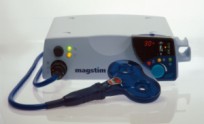
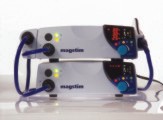
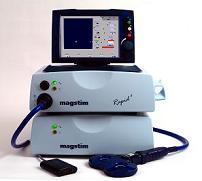
<p style="text-align: justify; ">Induce a small transient electrical current in human tissue by a very strong magnetic field created by a stimulating coil held close to the area of the body to be stimulated. It is non-invasive, painless and is used in diagnosis, prognosis and therapy in a range of nervous and psychiatric disorders, being able to stimulate the human cortex and all spinal roots, as well as peripheral nerves, easily and painlessly.</p>
<ul>
<li style="text-align: justify; "><span style="text-align: left; ">Magstim 200²<br /></span><span>Based upon the original Magstim design, the new Magstim 200² monophasic transcranial stimulator draws upon the years of knowledge and expertise gathered in both the clinical and research environments. The result is an innovative design that will enhance the company's reputation and establish the new Magstim range as the system of preferred choice.<br /><br /> </span></li>
<li style="text-align: justify; "><span>BiStim²<br /></span><span>BiStim² provides an effective upgrade path that allows users to take full advantage of the Magstim 200² modularity.<br /></span><span>The potential to combine two units offers fully programmable paired pulse stimulation through a single stimulating coil. The ability to change pulse intervals and to control independently the power level of each Magstim 200² allows for sub- and supra-threshold conditioning and secondary pulses to investigate inhibitory and facilitatory circuits.<br /> </span></li>
<li style="text-align: justify; "><span>Rapid²<br /></span><span>BiStim2 Repetitive Transcranial Magnetic Stimulation (rTMS) works by inducing electrical currents in tissue using a non-invasive stimulating coil at frequencies of up to 100Hz. The stimulating coil is placed near the intended site of stimulation and trigger pulses initiate brief magnetic pulses.<br /></span><span>The magnetic fields can pass through clothing, tissue and bone to reach otherwise inaccessible areas. One feature of magnetic stimulation is that it is less likely to stimulate pain fibres at the skin surface, reducing the discomfort when compared with conventional electrical stimulation.<br /></span><span>Magstim Rapid² magnetic stimulators combine stimulation frequencies from 1Hz to 100Hz with a touch screen interface which controls every aspect of the stimulator's control and operation.<br /></span><span>This new range of rapid rate stimulators replaces the well established Magstim Rapid and Magstim Super Rapid and has been developed as a result of extensive consultation with existing users throughout the world, both in the clinical and research arenas.</span></li>
</ul>
<p>(<i><a class="external-link" href="http://www.magstim.com/magneticstimulators.html" target="_blank">read more...</a></i>)</p>
</td>
<td>
<p> </p>
<p> </p>
<p> </p>
<p> </p>
<p> </p>
<p> </p>
<p><img src="https://www.unife.it/progetto/neurolab/image/Magstim.jpg" alt="" class="image-inline" title="" /></p>
<p> </p>
<p><img src="https://www.unife.it/progetto/neurolab/image/BiStim.jpg" alt="" class="image-inline" title="" /></p>
<p> </p>
<p> </p>
<p> </p>
<p><img src="https://www.unife.it/progetto/neurolab/image/rapid.jpg" alt="" class="image-inline" title="" /></p>
</td>
</tr>
<tr>
<td>
<p><br /><strong>MAXNC 15 CL</strong></p>
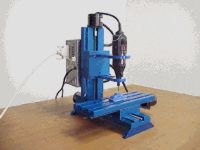
<p style="text-align: justify; ">The MAXNC 15 CL2 is a closed loop version of the MAXNC 15 stepper machine but using the MAXNC new CL2 motion system for control. This new controller run 4 axes from a single parallel port from any PC, 66 mega Herts or faster (486, Pentium, AMDK, etc.)from DOS or from WINDOWS. The control reads the encoders at a rate of over 60,000 times a second and the feed-back is analyzed by the software. Based on the position of the encoders, the outputs to the motors are advanced, retarded or modified as needed. The speed at which the software operates also allows the control of the spindle motor speed from the CNC program. The servo motors used in the CL2 systems are of step configuration to obtain very fast acceleration an deceleration rates, important in continuous contouring operations. Machine operates at up to 60 inches per minute with the standard 20 threads per inch screws. The machine comes equipped with combination HOME and LIMIT switches and a socket for the 3D digitizer.</p>
<p>(r<i><a class="external-link" href="http://www.maxnc.com" target="_blank">ead more...</a></i>)</p>
</td>
<td>
<p> </p>
<p> </p>
<p><img src="https://www.unife.it/progetto/neurolab/image/maxnc15.jpg" alt="" class="image-inline" title="" /></p>
<p> </p>
</td>
</tr>
<tr>
<td style="text-align: justify; ">
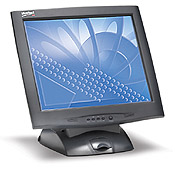
<p><br /><strong>MicroTouch™ M170 17" LCD Touch Monitor</strong></p>
The MicroTouch™ M170 Touch Monitor from 3M was designed to be different. The result of extensive customer research, innovative industrial design, and years of touch technology expertise, the M170 monitor's unique mechanical and technology features offer premium performance for a wide-range of implementations.<br /> 
<ul>
<li><span>Ships with all cables fully attached and ready for use</span></li>
<li><span>Display angle adjustable within a 95° range</span></li>
<li><span>Out-of-the-box wall mountable</span></li>
<li><span>Peripheral Attachment System - Mount your preferred peripheral device or simultaneously mount multiple peripheral devices</span></li>
<li><span>Cables, connections and power supply are all concealed, and peripheral cables can be concealed as well</span></li>
<li><span>Complete multimedia package, lockable on-screen display controls, and full VESA-mounting compliance</span></li>
</ul>
(<i><a class="external-link" href="http://www.3mitalia.it/3M/it_IT/azienda-it/" target="_blank">read more...</a></i>)</td>
<td>
<p> </p>
<p><img src="https://www.unife.it/progetto/neurolab/image/m170.jpg" alt="" class="image-inline" title="" /></p>
</td>
</tr>
<tr>
<td><br />
<p><strong>TDT Data Acquisition</strong></p>
TDT offers a number of versatile, user-programmable DSP-based systems for real-time stimulus generation and data acquisition featuring our System 3 line of real-time processors. Systems with 24-bit Sigma-Delta A/D and D/A converters offer unparalleled precision and signal-to-noise ratios while those with 16-bit PCM converters are best-suited for applications that require minimal group delay. You can customize the DSP function using circuits designed with TDT’s RPvds Visual Design Studio. These circuits can be controlled directly through RPvds, TDT applications software, or through custom code written using MATLAB, Visual C++, Visual Basic, or any language that supports ActiveX controls.<br /><br /> 
<ul>
<li style="text-align: justify; "><span>RZ2 Z-Series Base Station<br /></span><span>The RZ2 processes and filters acquired signals and can be used to control digital I/O and/or generate analog signals. Designed for up to 256-channel data acquisition, the RZ2 is the first in TDT’s Z-Series line of ultra high performance processors. Z-Series processors feature four or eight ultra fast digital signal processors networked on a novel bus architecture that speeds both onboard communication and memory access. Faster clock speeds and enhanced processing power not only improve channel count, but also allow for simultaneous acquisition on all 256 channels at sampling rates up to ~50 kHz. High bandwidth data is streamed from a Z-Series PreAmp to the RZ2 over a fast fiber optic connection. Our innovative Optibit optical PC interface ensures fast and reliable data transfer from the RZ2 to the PC. The RZ2 also features 16 channels of analog I/O, 24 bits of digital I/O, two legacy optical inputs for Medusa PreAmps, and an onboard LCD for system status display.</span></li>
<li style="text-align: justify; "><span>Z-Series Preamplifiers 128 channel<br /></span><span>TDT’s high-count Z-Series preamplifiers feature a fast new fiber optic connection capable of simultaneously transferring up to 256 channels at full precision. This extended bandwidth supports sampling rates up to ~50 kHz and improves signal fidelity, spike discrimination, sorting, and analysis. Used exclusively with Z-Series base stations, preamps are available in 64, 128 or 256-channel models. Our custom 18-bit hybrid A/D architecture offers the advantages of Sigma-Delta converters at significantly lower power. Dual-battery architecture allows one battery to power the preamp while its backup is charged over an isolated charging circuit. LEDs indicate battery status as well as spike detection and clipping on each channel.</span></li>
<li style="text-align: justify; "><span>Optibit Interface<br /></span><span>Our high-speed interfaces provide communication between your PC and System 3, zBus-based, hardware components. Designed for users requiring real-time control of System 3 devices, each consists of a PCI card for your computer and one or more interface modules that mount in zBus device caddies. These interfaces also provide automatic device identification, system initialization and a single clock that phase-locks all devices across all caddies. The Optibit version, featuring fiber optic data transmission and improved throughput, is also available. This design minimizes the potential for communication errors caused by electromagnetic interference and allows lossless data transmission over longer distances</span></li>
</ul>
<p>(<i><a class="external-link" href="http://www.tdt.com/" target="_blank">read more...</a></i>)</p>
</td>
<td>
<p> </p>
<p> </p>
<p> </p>
<p> </p>
<p> </p>
<p> </p>
<p> </p>
<p> </p>
<p> </p>
<p><img src="https://www.unife.it/progetto/neurolab/image/RZ2.gif" alt="" class="image-inline" title="" /></p>
<p> </p>
<p> </p>
<p> </p>
<p> </p>
<p> </p>
<p> </p>
<p> </p>
<p> </p>
<p> </p>
<p> </p>
<p><img src="https://www.unife.it/progetto/neurolab/image/PZ2128.jpg" alt="" class="image-inline" title="" /></p>
<p><img src="https://www.unife.it/progetto/neurolab/image/pz5f05.jpg" alt="" class="image-inline" title="" /></p>
<p> </p>
</td>
</tr>
<tr>
<td>
<p><strong>CED 1902</strong></p>
<p style="text-align: justify; ">The 1902 is a versatile modular unit designed to work with modern computer-controlled data acquisition systems. Developed for a broad range of applications, the 1902 accepts biological and instrumentation signals from a wide variety of sources.</p>
<p style="text-align: justify; ">It is available in single or multi channel configurations. Communication with the computer is achieved through a serial line, allowing multiple sets of units to be controlled simultaneously.</p>
<p style="text-align: justify; ">For EMG, EEG, ECG, ERG, Evoked response, Skin Conductance, Tremor Measurement, Auditory Brainstem and many more life science and engineering research applications.<br />(<i><a class="external-link" href="http://ced.co.uk/" target="_blank">read more...</a></i>)</p>
</td>
<td>
<p> </p>
<p><img src="https://www.unife.it/progetto/neurolab/image/1902.jpg" alt="" class="image-inline" title="" /></p>
</td>
</tr>
<tr>
<td><br />
<p><strong>CED Micro 1401 </strong></p>
<p style="text-align: justify; ">The Micro1401 mk 2 is a low cost, versatile data acquisition unit. The on-board processor with high speed memory is optimised for real time processing, free from the constraints of the host computer operating system. Fast and accurate sampling coupled with simultaneous output offers extensive on-line experimental control.<br />The Micro1401 records waveform data, digital (event) and marker information and can simultaneously generate waveform and digital outputs in real-time for multi-tasking experimental control. It features high-speed waveform capture at rates up to 500kHz with 16-bit resolution. The 32-bit RISC processor allows complex on-line analysis while freeing time for the host computer to perform other tasks, such as data manipulation and further analysis.</p>
<ul>
<li><span>Waveform I/O<br /></span><span>4 channels of 16-bit waveform input, ±5V, or ±10V more details<br /></span><span>Up to 28 waveform inputs via expansion units<br /></span><span>2 waveform output channels, 12-bit, ±5V or ±10V</span></li>
<li><span>Digital I/O<br /></span><span>16 digital inputs, 8 with change-of-state detection to micro-second accuracy<br /></span><span>16 digital outputs, 8 clocked for microsecond accurate switching<br /></span><span>Handshake lines for byte input and output</span></li>
<li><span>Clock and Events<br /></span><span>5 programmable clocks with 100 nS resolution more details<br /></span><span>BNC socket for clock inputs and event (clock start) connections<br /></span><span>Synchronisation option for multiple 1401s</span></li>
<li><span>Processor and Memory<br /></span><span>32-bit ARM7 processor running at 75 MHz<br /></span><span>1 MByte of read-write memory, option of 2 MBytes<br /></span><span>Flash memory holding operating firmware and self-test code</span></li>
</ul>
<p>(<i><a class="external-link" href="http://ced.co.uk/" target="_blank">read more...</a></i>)</p>
</td>
<td>
<p> </p>
<p><img src="https://www.unife.it/progetto/neurolab/image/ced.gif" alt="" class="image-inline" title="" /></p>
</td>
</tr>
<tr>
<td>
<p><strong>OptiTrack Optical Motion Capture</strong></p>
<p style="text-align: justify; "><span>Complete system of 6 infrared cameras sampling at 100Hz, included with software toolkits (Point Cloud, Rigid Body and Arena) to track single markers up to Full Body Motion Capture.</span></p>
<p>(<i><a class="external-link" href="http://www.optitrack.com/" target="_blank">read more...</a></i>)</p>
</td>
<td>
<p><img src="https://www.unife.it/progetto/neurolab/image/optitrack.jpg" title="" height="172" width="138" alt="" class="image-inline" /></p>
</td>
</tr>
<tr>
<td>
<p><strong>UPF - Trigger TTL device for E-Prime 2 Pro and 3</strong></p>
<p style="text-align: justify; "><span>The device include 8 logical TTL input/output ports (0 to +5V). Each port has a temporal resolution of 50 ns and the complete output voltage transition from GND to 5V takes approximately 400 µs. The device is controlled via microprocessor at 12 MHz.</span></p>
<p>A Windows compatible .dll enable communication with the device.</p>
<ul>
<li><span>Full E-Prime 2 Pro, 3 compatible</span></li>
<li><span>Direct USB software</span></li>
<li><span>Easy to use it</span></li>
<li><span>Guaranted millisecond accuracy</span></li>
<li><span>Compatible with other applications</span></li>
<li><span>Standard BNC connection</span></li>
</ul>
<span>(<i><a href="https://www.unife.it/progetto/neurolab/upf/upf" class="internal-link" target="_blank">read more...</a></i>)</span></td>
<td>
<p> </p>
<p><img src="https://www.unife.it/progetto/neurolab/image/back.jpg" alt="" class="image-inline" title="" /></p>
<p><img src="https://www.unife.it/progetto/neurolab/image/front.jpg" alt="" class="image-inline" title="" /></p>
</td>
</tr>
<tr>
<td></td>
<td></td>
</tr>
<tr>
<td></td>
<td></td>
</tr>
<tr>
<td></td>
<td></td>
</tr>
</tbody>
</table>]]></content:encoded>
    <dc:publisher>No publisher</dc:publisher>
    <dc:creator>Canto Rosario</dc:creator>
    <dc:rights></dc:rights>
    <dc:date>2017-03-01T11:23:28Z</dc:date>
    <dc:type>Pagina</dc:type>
  </item>


  <item rdf:about="https://www.unife.it/progetto/neurolab/contacts">
    <title>Contacts</title>
    <link>https://www.unife.it/progetto/neurolab/contacts</link>
    <description></description>
    <content:encoded xmlns:content="http://purl.org/rss/1.0/modules/content/"><![CDATA[<blockquote>
<p>Faculty of Medicine – D.S.B.C.S. Section of Human Physiology</p>
<p>Via Fossato di Mortara 17/19</p>
<p>44100 Ferrara – Italy</p>
<p>Phone: +39 0532 455338</p>
<p>Fax: +39 0532 455242</p>
<p>E-mail: <a href="mailto:luciano.fadiga@unife.it">luciano.fadiga@unife.it</a> -   <a href="mailto:rosario.canto@unife.it">rosario.canto@unife.it</a></p>
<p><a class="external-link" href="https://www.google.it/maps/place/Via+Fossato+di+Mortara,+17,+44121+Ferrara+FE/@44.8373051,11.6290319,17z/data=!3m1!4b1!4m5!3m4!1s0x477e4e3f4e650ca9:0x59aec8dcdf6ee61a!8m2!3d44.8373051!4d11.6312206?hl=it" target="_blank">Show MAP</a></p>
</blockquote>
<p><strong>How to reach us:</strong></p>
<p style="padding-left: 30px; ">by train/bus</p>
<blockquote>
<p style="padding-left: 60px; ">Railway Station - 10 minutes with the bus n.1, stop name "OSPEDALE".<br />Exiting from Station, go across the road and you will find the bus stop.<br />The bus leaves every 15 minutes: <a class="external-link" href="http://www.ami.fe.it/p/6/orari-e-linee-bus.html" target="_blank">see time table</a> for details.</p>
</blockquote>
<p>by plane</p>
<blockquote>
<p style="padding-left: 60px; ">International Airport "Guglielmo Marconi" - 50 minutes by car or taxi; otherwise you can reach the Bologna Central Railway Station in 30 minutes with the shuttle service AEROBUS, and from the Station to Ferrara Station by train in 40 minutes.</p>
<p style="padding-left: 60px; "> </p>
</blockquote>]]></content:encoded>
    <dc:publisher>No publisher</dc:publisher>
    <dc:creator>Canto Rosario</dc:creator>
    <dc:rights></dc:rights>
    <dc:date>2017-02-27T16:55:09Z</dc:date>
    <dc:type>Pagina</dc:type>
  </item>


  <item rdf:about="https://www.unife.it/progetto/neurolab/image/neurolab_brain.jpg">
    <title>neurolab_brain.jpg</title>
    <link>https://www.unife.it/progetto/neurolab/image/neurolab_brain.jpg</link>
    <description></description>
    
    <dc:publisher>No publisher</dc:publisher>
    <dc:creator>Canto Rosario</dc:creator>
    <dc:rights></dc:rights>
    <dc:date>2017-02-27T16:48:37Z</dc:date>
    <dc:type>Immagine</dc:type>
  </item>


  <item rdf:about="https://www.unife.it/progetto/neurolab/research">
    <title>Research</title>
    <link>https://www.unife.it/progetto/neurolab/research</link>
    <description></description>
    <content:encoded xmlns:content="http://purl.org/rss/1.0/modules/content/"><![CDATA[<ul>
<li><span>European Projects</span></li>
<ul>
<li>Tms and Action Observation</li>
<ul>
<li>Scientific Background. Studies carried out on monkeys (single neuron recordings from monkey premotor cortex [Di Pellegrino et al. 1992, Gallese et al.     1992]) and on normal human subjects (corticospinal excitability investigation by means of transcranial magnetic stimulation [Fadiga et al. 1995], brain imaging studies using functional magnetic resonance [Buccino et al. 2001] and positron emission tomography [Grafton et al. 1996]) have shown that during observation of actions performed by other individuals there is, in the observer, an activation of the motor system that simulates what would happen if the observer himself executed the observed action.<br />(<i>continue...</i>)</li>
</ul>
<li>Mirror</li>
<ul>
<li>The project will investigate the association between visual information and motor commands in the learning, representation and understanding of complex manipulative gestures. The reference scenario is that of a person performing goal driven arm/hand gestures such as pointing, scratching a body part, bringing food to the mouth etc.<br /><span>(</span><i>continue...</i><span>)</span></li>
</ul>
<li><span> Mirror System and Speech Recognition</span></li>
<ul>
<li><span>Does a mirror system exist for phonetic gestures recognition? According to the motor theory of speech perception, speech is perceived by matching articulatory gestures, which are embedded in listened words, on the listener’s motor repertoire (Lieberman 1979).<br /><span>(</span><i>continue...</i><span>)</span></span></li>
</ul>
<li>RobotCub</li>
<ul>
<li>Our main goal is to study cognition through the implementation of a humanoid robot the size of a 2 year old child: the iCub. This is an open project in many different ways: it will distribute its platform openly, it will develop software open-source, and we are open to including new partners and form collaboration worldwide.<br /><span>(<i>continue... PDF</i>)</span></li>
</ul>
<li>Contact</li>
<ul>
<li>As infants, did we learn to perceive and produce gestures for manipulation and speech independently, or are these two learning processes linked? Should robots?<br />(<i>continue...</i>)</li>
</ul>
</ul>
</ul>]]></content:encoded>
    <dc:publisher>No publisher</dc:publisher>
    <dc:creator>Canto Rosario</dc:creator>
    <dc:rights></dc:rights>
    <dc:date>2016-01-07T16:48:32Z</dc:date>
    <dc:type>Pagina</dc:type>
  </item>


  <item rdf:about="https://www.unife.it/progetto/neurolab/pdf/2014_2_GaveauJBerretBDemougeotLFadigaLPozzoTPapaxanthisC.pdf">
    <title>2014_2_GaveauJBerretBDemougeotLFadigaLPozzoTPapaxanthisC.pdf</title>
    <link>https://www.unife.it/progetto/neurolab/pdf/2014_2_GaveauJBerretBDemougeotLFadigaLPozzoTPapaxanthisC.pdf</link>
    <description></description>
    
    <dc:publisher>No publisher</dc:publisher>
    <dc:creator>Canto Rosario</dc:creator>
    <dc:rights></dc:rights>
    <dc:date>2016-01-07T16:14:15Z</dc:date>
    <dc:type>File</dc:type>
  </item>


</rdf:RDF>